
LIVERMORE, Calif. – Starting Monday, fast food workers in California will see a significant increase in their pay as a new law goes into effect, providing more financial stability to a profession that has historically been known for low wages. This move has been welcomed by many workers and labor unions, but it has also raised concerns among fast food franchise owners who fear the impact it will have on their businesses and the economy.
The new law, which was passed by Democrats in the state Legislature last year, will raise the minimum wage for fast food workers to $20 an hour. This is a significant increase from the current minimum wage of $16 per hour and is expected to benefit over 500,000 workers in the state. The law was passed in recognition of the fact that many fast food workers are not teenagers earning pocket money, but adults who rely on their jobs to support themselves and their families.
One such worker is Ingrid Vilorio, an immigrant who started working at a McDonald’s shortly after arriving in the United States in 2019. Fast food was her full-time job until last year when she had to take on multiple jobs to make ends meet. Vilorio, who now works about eight hours a week at a Jack in the Box, expressed her gratitude for the $20 raise, saying that it would have made a big difference if it had come sooner. She added that she would not have had to look for other jobs in different places if she had been earning a decent wage at her fast food job.
While the law has been welcomed by workers like Vilorio, it has also sparked concerns among fast food franchise owners. The trade association representing these franchise owners had initially supported the law, but since its passing, many have expressed their worries about the impact it will have on their businesses, especially in the current slowing economy.
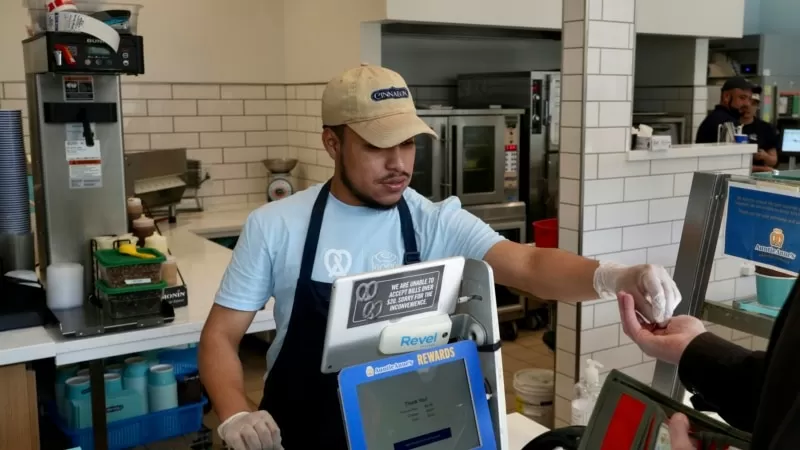
Alex Johnson, who owns 10 Auntie Anne’s Pretzels and Cinnabon restaurants in the San Francisco Bay Area, shared his concerns about the law’s impact on his business. He revealed that his sales have slowed down in 2024, leading him to lay off his office staff and rely on his parents to help with payroll and human resources. The increase in wages will cost Johnson about $470,000 each year, and he will have to raise prices by 5% to 15% at his stores. He also mentioned that he is no longer hiring or seeking to open new locations in California due to the financial strain caused by the law.
Johnson’s situation is not unique, as many other fast food franchise owners are facing similar challenges. The increase in wages will lead to a rise in prices, making it difficult for these businesses to compete in a state that is already known for its high cost of living. Some owners have even expressed concerns about having to sell or close their businesses due to the slim profit margins caused by the law.
However, supporters of the law argue that the increase in wages will not have a negative impact on employment, as some may fear. In fact, data from the past decade has shown that as the minimum wage in California has doubled, employment has not decreased. Michael Reich, a labor economics professor at the University of California-Berkeley, shared his surprise at the lack of negative effects on employment. He even mentioned that there have been positive employment effects in some cases.
Reich also pointed out that while the statewide minimum wage is $16 per hour, many cities in California have their own minimum wage laws, which set the rate even higher. This means that for some fast food restaurants, the jump to $20 per hour will not be as significant.
The new law was the result of a compromise between the fast food industry and labor unions, who had been in a dispute over wages, benefits, and legal liabilities for nearly two years. The law was born out of private negotiations between the two parties, including the unusual step of signing confidentiality agreements.
The law applies to fast food restaurants that offer limited or no table service and are part of a national chain with at least 60 establishments nationwide. However, restaurants operating inside a grocery store and those that produce and sell bread as a standalone menu item are exempt from the law.
There was some confusion initially about whether the bread exemption applied to Panera Bread restaurants. Bloomberg News reported that this change would benefit Greg Flynn, a wealthy campaign donor to Governor Newsom. However, the Newsom administration clarified that the wage increase law does apply to

