
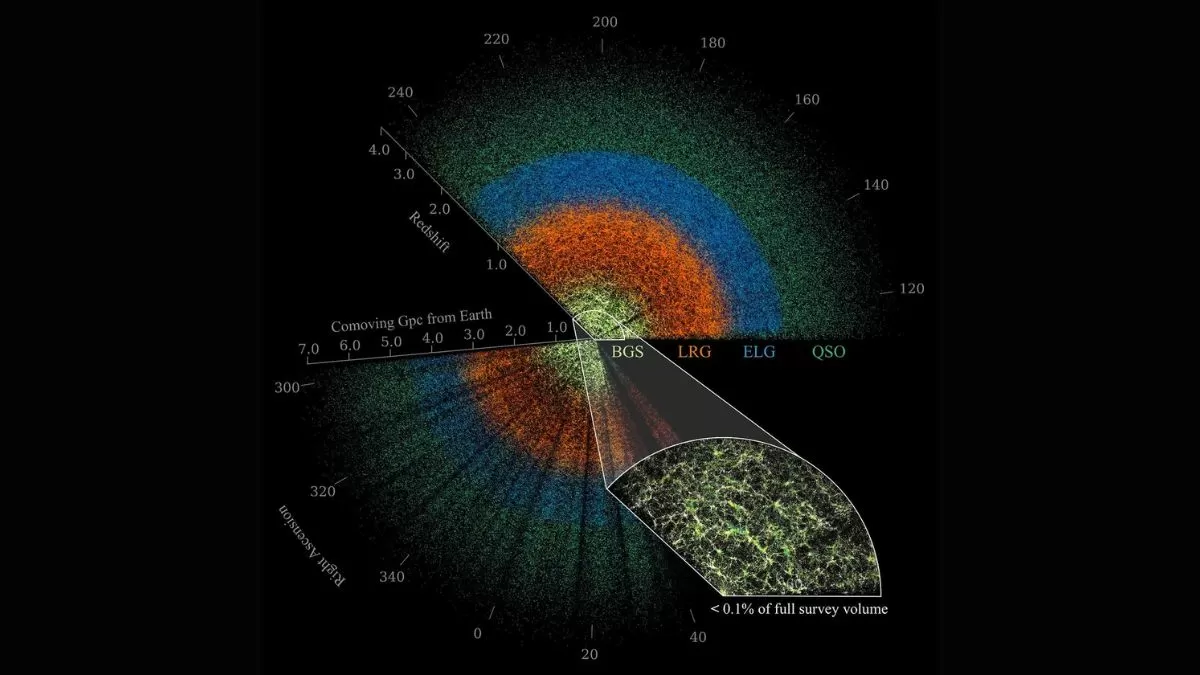
New research from the Dark Energy Spectroscopic Instrument (DESI) project has revealed groundbreaking insights into the mysterious force known as dark energy. Scientists have long believed that dark energy, a force that is responsible for the accelerated expansion of the universe, remained constant over time. However, the latest findings from DESI suggest that dark energy may actually be changing, raising new questions about the evolution of our cosmos.
DESI is a powerful instrument, located at the Kitt Peak National Observatory in Arizona, designed to map and measure the properties of over 35 million galaxies. Through analyzing the light from these galaxies, scientists are able to determine the distance and velocity of each galaxy, providing a detailed picture of the universe’s expansion. This information is crucial in understanding the nature and behavior of dark energy.
The project, which began in 2016, has been collecting data at an unprecedented rate, mapping 15 million galaxies in just three years. This massive amount of data has allowed scientists to make significant breakthroughs in our understanding of the universe. One of the most intriguing findings from DESI’s data is the possibility that dark energy may not be constant after all.
Dr. Martin White, a senior member of the DESI collaboration, explains, “Our previous understanding was that dark energy remained constant, like a force of nature that is unchanging. But DESI’s data suggests that this may not be true. We are seeing hints that the strength of dark energy may be evolving over time.”
This discovery challenges traditional models of cosmology that assume a stable influence of dark energy on the expansion of the universe. For decades, scientists have relied on this assumption to explain the observed expansion of the universe. However, with DESI’s data, it seems that there may be more to the story.
The implications of this breakthrough are immense, as it could potentially change our entire understanding of the evolution of the universe. If dark energy is indeed evolving, it raises questions about the future of our cosmos and what impact this may have on the fate of our universe.
Scientists are now reevaluating their current models and theories to incorporate the latest findings from DESI. Dr. Daniel Eisenstein, the director of DESI, says, “Our results open up a whole new avenue of research. We are excited to see where this will take us in our quest to understand the true nature of dark energy.”
While this new discovery may seem daunting, it presents a thrilling opportunity for scientists to deepen their understanding of the universe and push the boundaries of our knowledge. DESI’s data has already led to numerous groundbreaking discoveries, and as the project continues, we can expect even more revolutionary insights.
DESI’s findings have not only challenged longstanding assumptions about the behavior of dark energy but also shed light on the nature of cosmic evolution. By mapping millions of galaxies, DESI has provided us with a more detailed and comprehensive understanding of the universe and its mysteries.
This breakthrough also highlights the importance of technological advancements in pushing the boundaries of scientific research. The incredible capabilities of the DESI instrument have allowed scientists to make significant strides in understanding the complexities of our universe. This achievement serves as a testament to the power of collaboration between technology and science.
The DESI project is far from over, with plans to map over 35 million galaxies in the next five years. This ongoing research will undoubtedly continue to unravel the secrets of the universe and potentially reveal even more astonishing revelations.
In conclusion, DESI’s latest findings have challenged long-held beliefs about the nature of dark energy and opened the door for new understandings of the universe’s expansion. This discovery serves as a reminder that our knowledge of the universe is ever-evolving, and we must continue to push the boundaries of scientific research to unravel its mysteries. With DESI’s groundbreaking data, we are one step closer to understanding the true nature of our cosmos.

