
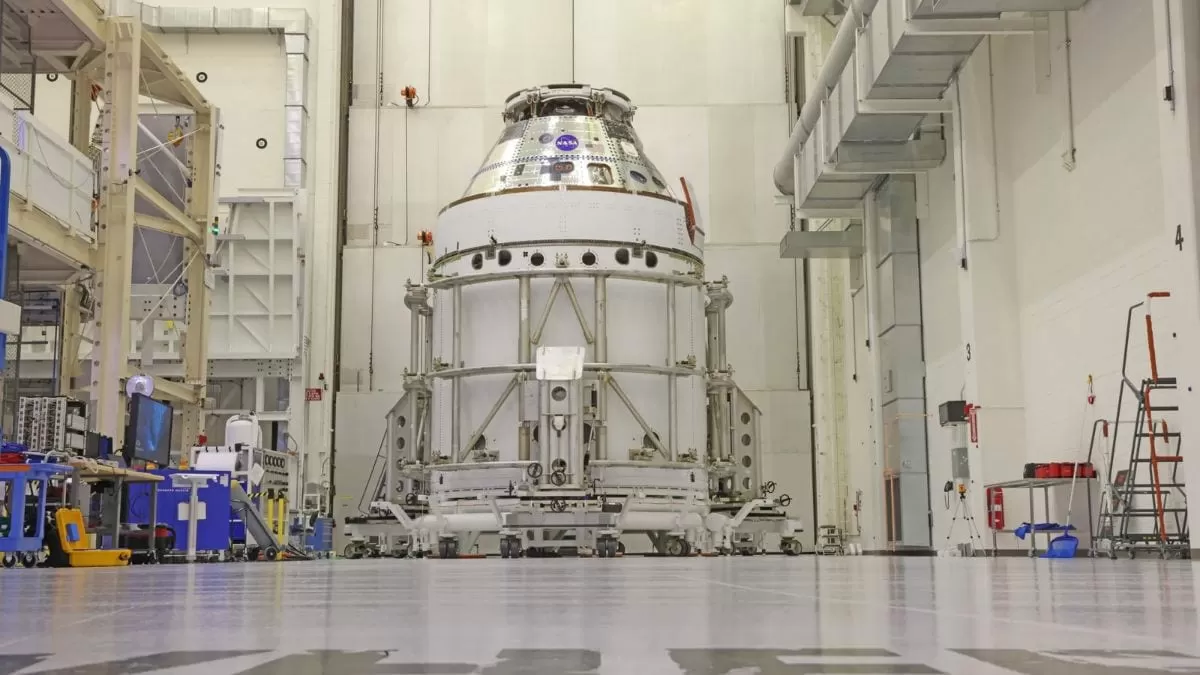
NASA’s Artemis II Orion spacecraft is one step closer to its highly anticipated mission around the Moon. The latest development comes with the installation of three spacecraft adapter jettison fairings on its service module at Kennedy Space Center. These panels serve as a crucial component in protecting the spacecraft’s solar arrays during launch and while in space, ultimately paving the way for a successful mission.
The Artemis II mission, also known as Exploration Mission-2 (EM-2), is an integral part of NASA’s Artemis program. This ambitious program aims to land the first woman and the next man on the lunar surface by 2024, as well as establish a sustainable presence on the Moon. Artemis II is a significant stepping stone towards achieving these goals, as it will be the first crewed mission to loop around the Moon since the Apollo 17 mission in 1972.
The installation of the three spacecraft adapter jettison fairings is a major milestone in the preparation of the Artemis II spacecraft. These fairings, each measuring approximately 10 feet in diameter, will provide protection to the solar arrays from the extreme conditions of space during launch. They are designed to withstand the intense heat, wind, and acoustic forces generated by the powerful Space Launch System (SLS) rocket, which will propel the spacecraft into orbit.
Once the spacecraft is in space, these fairings will detach, allowing the solar arrays to deploy. The solar arrays, which convert sunlight into electricity, are crucial for the spacecraft’s power supply. They will provide energy for the spacecraft’s systems, including the life support systems and communication equipment, as well as charging the batteries for the return journey to Earth.
The installation of the fairings was a complex and delicate process, carried out by a team of engineers and technicians at the Kennedy Space Center. Each fairing was carefully attached to the service module using bolts and pins, ensuring a secure fit. The team also performed various tests and checks to verify the proper functioning of the fairings.
The three spacecraft adapter jettison fairings were designed and built by NASA’s Orion program, in collaboration with Lockheed Martin, the prime contractor for the Orion spacecraft. Orion is the only spacecraft in the world capable of taking humans beyond low-Earth orbit. It is also designed to withstand the extreme temperatures and radiation levels of deep space, making it the ideal spacecraft for the Artemis II mission.
The upcoming mission will be the second uncrewed flight test for the Orion spacecraft, following the successful Exploration Flight Test-1 (EFT-1) in 2014. During EFT-1, the spacecraft traveled 3,600 miles from Earth, and the fairings performed flawlessly, proving their effectiveness in protecting the solar arrays.
The Artemis II mission is expected to take place in 2023, and it will be the first time humans have ventured beyond the Moon’s orbit since 1972. The spacecraft will carry a crew of four astronauts, who will spend approximately ten days in space, looping around the Moon before returning to Earth.
Aside from carrying astronauts, the mission will also perform a series of tests and demonstrations to pave the way for future missions to the Moon, Mars, and beyond. These include testing the spacecraft’s deep space navigation and communication systems, as well as its ability to dock with the Gateway, a lunar outpost that will serve as a stepping stone for exploring the Moon’s surface.
The success of the Artemis II mission will be a significant achievement for NASA and the Artemis program. It will demonstrate the agency’s capabilities in deep space exploration, as well as bring us one step closer to realizing our goal of a sustainable presence on the Moon.
In conclusion, the installation of the three spacecraft adapter jettison fairings on the Orion spacecraft marks a significant milestone in the preparations for the Artemis II mission. These fairings will play a crucial role in protecting the spacecraft’s solar arrays during launch and in space, ultimately enabling a successful mission to the Moon. We eagerly await the next steps in this exciting journey towards human exploration of deep space.

