
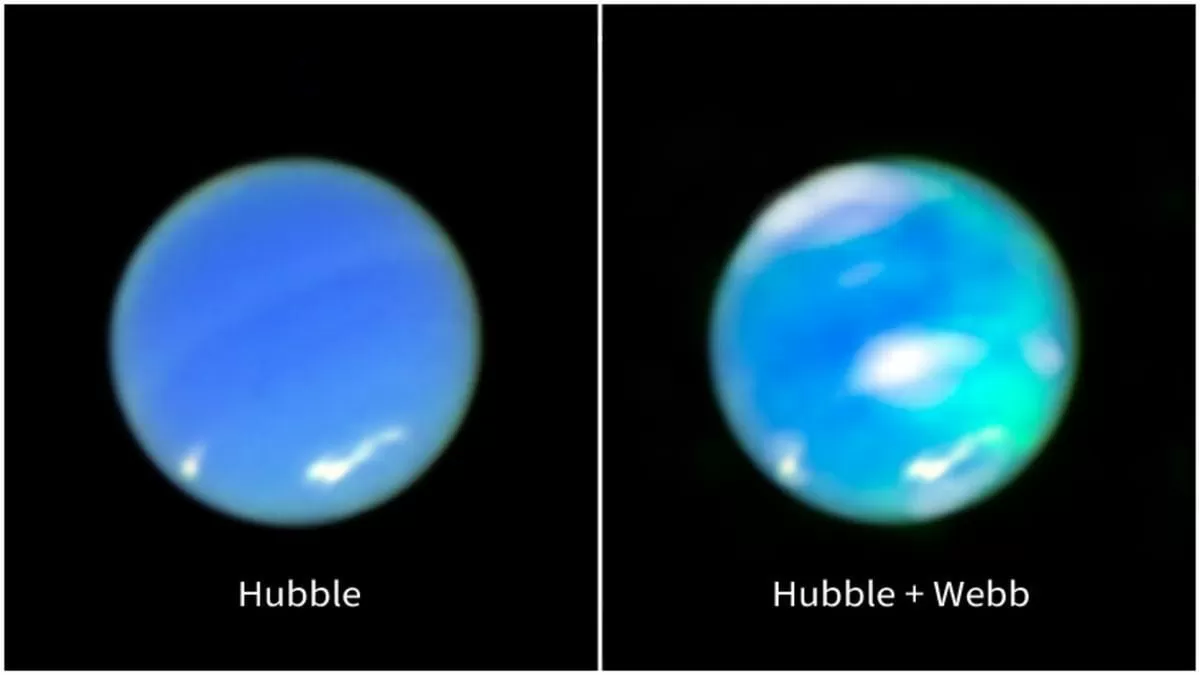
The James Webb Space Telescope has made history once again. This revolutionary telescope, which was first launched in December 2021, has provided us with the first-ever direct images of Neptune’s auroras. This has allowed scientists to gain a better understanding of the ice giant’s atmosphere and has revealed some surprising details about the planet.
Neptune is the eighth and farthest planet from the Sun in our solar system, and it is known for its beautiful blue color. But there is more to this ice giant than meets the eye. Its magnetic field is tilted and offset, which means that its auroras appear in unexpected locations. This makes Neptune’s auroras unique and different from those found on Earth, Jupiter, or Saturn. Thanks to the James Webb Space Telescope, we now have a closer and clearer look at these elusive auroras.
The images captured by the telescope show that Neptune’s auroras are not uniform, but rather they appear as bright spots scattered across the planet’s northern and southern hemispheres. According to scientists, this is due to the complex interaction between the planet’s magnetic field and solar wind particles. As these particles collide with Neptune’s atmosphere, they produce a stunning light show in the form of auroras.
But perhaps the most exciting finding from the James Webb Telescope’s observations is the detection of H₃⁺, a key ion linked to the planet’s auroras. This discovery has been described as a game-changer by scientists as it provides valuable insights into the composition and behavior of Neptune’s atmosphere. H₃⁺ is a positively charged molecule consisting of three hydrogen atoms, and its presence in the planet’s auroras suggests that strong electric currents are responsible for generating these bright spots.
One of the reasons this discovery is significant is that H₃⁺ has only been observed in the atmospheres of Jupiter and Saturn before. This means that Neptune is now the third planet in our solar system to have this molecule present, which could change our understanding of its atmospheric processes. The James Webb Telescope’s ability to detect H₃⁺ and capture images of Neptune’s auroras has opened up a whole new world of possibilities for astronomers and planetary scientists.
The unprecedented images of Neptune’s auroras have also surprised scientists with their size. Unlike the auroras on Earth, which are typically confined to the polar regions, Neptune’s auroras extend much further towards the equator. This is because the planet’s magnetic field is heavily tilted, resulting in different regions of the atmosphere being exposed to solar winds at different times. This phenomenon is known as magnetic reconnection and is responsible for the scattered placement of the auroras.
The James Webb Telescope’s observations have also shed light on the behavior of Neptune’s atmosphere. The images show that the auroras are constantly changing in intensity, shape, and location, which indicates a dynamic and active atmosphere. This discovery has also raised questions about the similarities and differences between Neptune’s auroras and those found on other gas giants in our solar system.
The excitement surrounding the James Webb Telescope’s images of Neptune’s auroras is not just limited to scientists. These stunning images have captured the imagination of people worldwide, who are now marveling at the beauty and wonder of our solar system’s distant neighbors. The detailed and high-resolution images have also sparked a renewed interest in exploring Neptune and its moons, with some even suggesting future missions to study the planet’s atmosphere up close.
The James Webb Space Telescope has revolutionized our understanding of the universe since its launch. Its latest accomplishment in capturing the first-ever direct images of Neptune’s auroras has added a new layer of knowledge to our understanding of this distant ice giant. The telescope has proven its value once again, and we can’t wait to see what other exciting discoveries it has in store for us in the future.

