
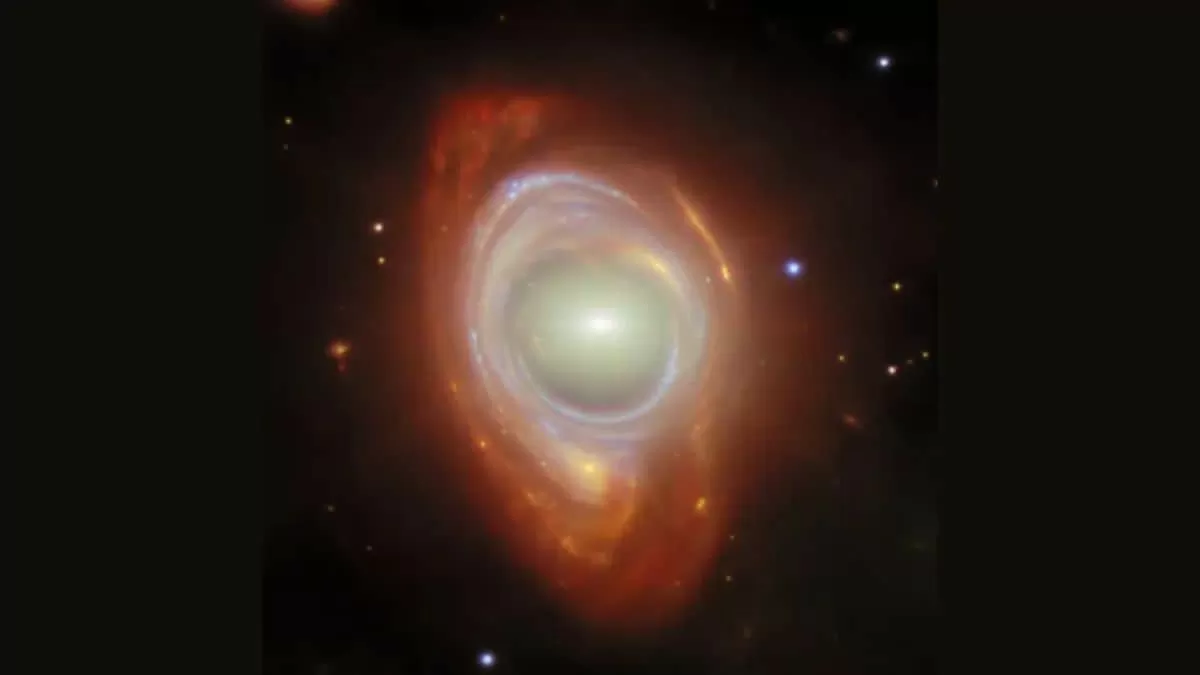
A new image from the James Webb Space Telescope has taken the world of astronomy by storm. The image, captured in the Hydrus constellation, reveals a stunning phenomenon known as an Einstein ring. This rare occurrence, predicted by Einstein’s theory of general relativity, has left scientists and space enthusiasts in awe.
An Einstein ring is formed when a massive foreground galaxy bends the light from a hidden background galaxy, creating a near-perfect ring. This effect is a result of the gravitational lensing, where the gravity of the foreground galaxy acts as a lens, magnifying and distorting the light from the background galaxy. The result is a mesmerizing ring of light, resembling a cosmic halo.
The James Webb Space Telescope, also known as JWST, is a joint project between NASA, the European Space Agency, and the Canadian Space Agency. It is the successor to the iconic Hubble Space Telescope and is set to revolutionize our understanding of the universe. With its advanced technology and capabilities, the JWST is able to capture images with unprecedented clarity and detail, allowing us to see the universe in a whole new light.
The newly released image from the JWST has captured the attention of astronomers and space enthusiasts alike. The Einstein ring in the Hydrus constellation is a sight to behold, with its intricate and delicate structure. The ring is formed by a massive galaxy located 10 billion light-years away, acting as a lens for a smaller galaxy located behind it. This gives us a glimpse into the early universe, as the light from the background galaxy has taken billions of years to reach us.
The discovery of this Einstein ring is a testament to the power of Einstein’s theory of general relativity. This theory, proposed over a century ago, has been proven time and again through various astronomical observations. The formation of an Einstein ring is just one of the many phenomena predicted by this theory, and its confirmation through the JWST’s image is a significant milestone in our understanding of the universe.
But the significance of this discovery goes beyond just confirming a theory. The Einstein ring also serves as a powerful tool for astronomers to study galaxies from the early universe. The gravitational lensing effect allows us to see these galaxies in greater detail, providing valuable insights into their formation and evolution. This, in turn, helps us piece together the puzzle of how our universe came to be.
The James Webb Space Telescope has only been in operation for a short time, and yet it has already made a groundbreaking discovery. This is just the beginning, as the JWST is expected to uncover many more mysteries of the universe in the years to come. Its advanced technology and capabilities have opened up a whole new world of possibilities for astronomers, and we can only imagine what other wonders it will reveal.
The release of this image has sparked excitement and curiosity among people all over the world. It serves as a reminder of the vastness and beauty of our universe, and the endless possibilities that lie beyond our reach. The JWST’s image of the Einstein ring in the Hydrus constellation is a testament to human ingenuity and our unquenchable thirst for knowledge.
In conclusion, the James Webb Space Telescope has once again proven its worth with the stunning image of an Einstein ring in the Hydrus constellation. This discovery not only confirms Einstein’s theory of general relativity but also opens up new avenues for studying the early universe. As we continue to explore and unravel the mysteries of our universe, the JWST will undoubtedly play a crucial role in shaping our understanding of the cosmos.

