
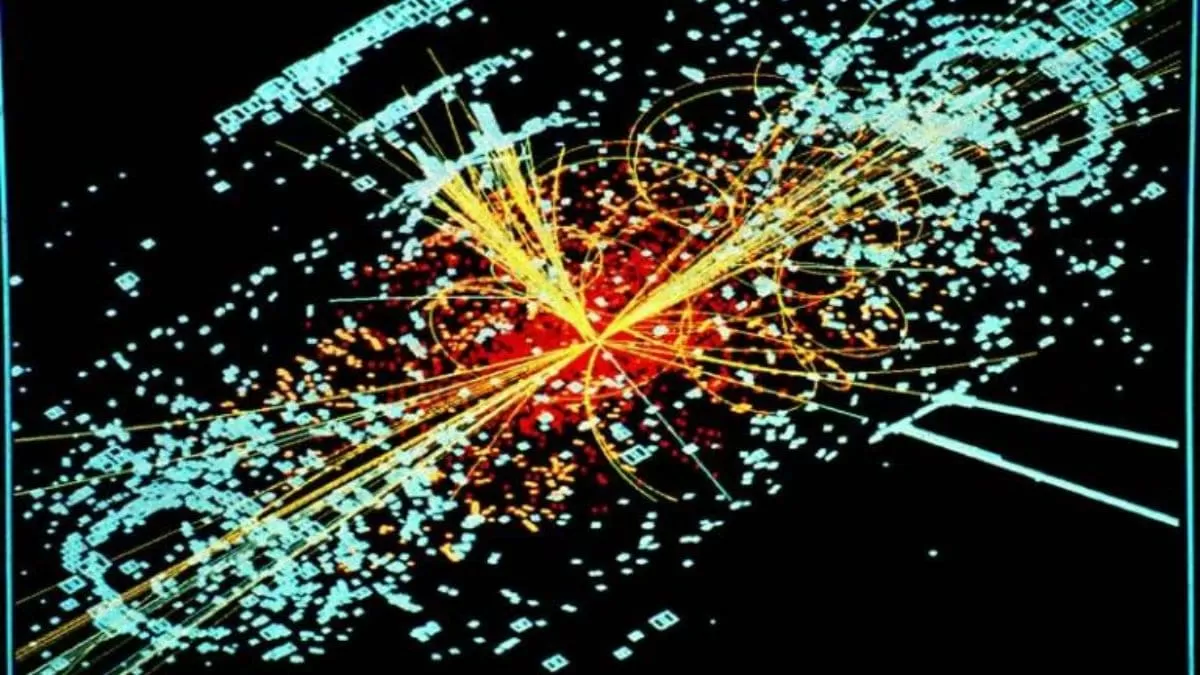
A groundbreaking discovery has been made by the LHCb experiment at CERN, shedding light on the mysterious nature of the universe. Scientists have found a major difference in the decay of matter and antimatter in beauty-lambda baryons, which provides a crucial insight into why our universe is dominated by matter.
For years, scientists have been puzzled by the lack of antimatter in the universe. According to the Big Bang theory, equal amounts of matter and antimatter should have been created at the beginning of the universe. However, as we look around us, we find that matter vastly outweighs antimatter. This disparity has been one of the greatest mysteries in physics, and the recent discovery at CERN has brought us closer than ever to understanding it.
The LHCb experiment, located at the world’s largest particle accelerator, the Large Hadron Collider (LHC), is dedicated to studying the subtle differences between matter and antimatter. Until now, scientists have only observed these differences in particles containing charm quarks. But with the latest research, the focus has shifted to beauty-lambda baryons, which are larger particles containing bottom quarks.
The study, published in the journal Nature, found that the beauty-lambda baryons decay differently depending on whether they are made of matter or antimatter. This difference in decay, known as CP violation, is crucial as it is one of the key mechanisms that could explain why the universe contains more matter than antimatter.
What makes this discovery even more remarkable is the incredibly low probability of this difference occurring by chance. The LHCb scientists found that the chance of this happening randomly is less than one in three million. This astonishingly low probability provides strong evidence that there must be some yet unknown mechanism that favors the creation of matter over antimatter.
The team at LHCb has been studying beauty-lambda baryons by colliding protons at extremely high energies, producing billions of particles every second. They then carefully analyze the decay of these particles to look for any differences between matter and antimatter. This requires state-of-the-art technology and precise measurements, and the team has been working tirelessly to achieve these results.
The discovery of CP violation in beauty-lambda baryons is a huge step forward in our understanding of the universe. It not only provides a possible explanation for the matter-antimatter asymmetry but also challenges the existing theories of particle physics. This finding opens up new avenues for research and could potentially lead us to a better understanding of the fundamental laws of nature.
Dr. Marcin Kucharczyk, a research scientist at CERN and lead author of the study, said, “This discovery is a major milestone for the LHCb experiment and for the field of particle physics. It has taken years of hard work and dedication to reach this point, and we are thrilled to finally make this breakthrough.”
The discovery of CP violation in beauty-lambda baryons is just the beginning. The LHCb team plans to continue their research and look for other particles that exhibit this difference in decay. They hope that with enough data, they can further refine their measurements and possibly uncover the underlying mechanism behind this phenomenon.
The implications of this discovery go far beyond just particle physics. It has the potential to answer one of the most fundamental questions about the universe – why is there more matter than antimatter? It could also have practical applications, such as improving our understanding of the universe’s fundamental forces and potentially leading to new technologies.
As we delve deeper into the mysteries of the universe, we are constantly reminded of how little we truly know. But with each new discovery, we are one step closer to unraveling the secrets of our universe. The LHCb experiment’s latest findings are a testament to the power of human curiosity and determination, and it is a momentous achievement for the scientific community.
This breakthrough at CERN reminds us of the importance of investing in scientific research. It is only through the tireless efforts of scientists and the support of institutions like CERN that we can continue to push the boundaries of human knowledge. The discovery of CP violation in beauty-lambda baryons is a reminder that the pursuit of knowledge knows no boundaries and that the possibilities are endless.

