
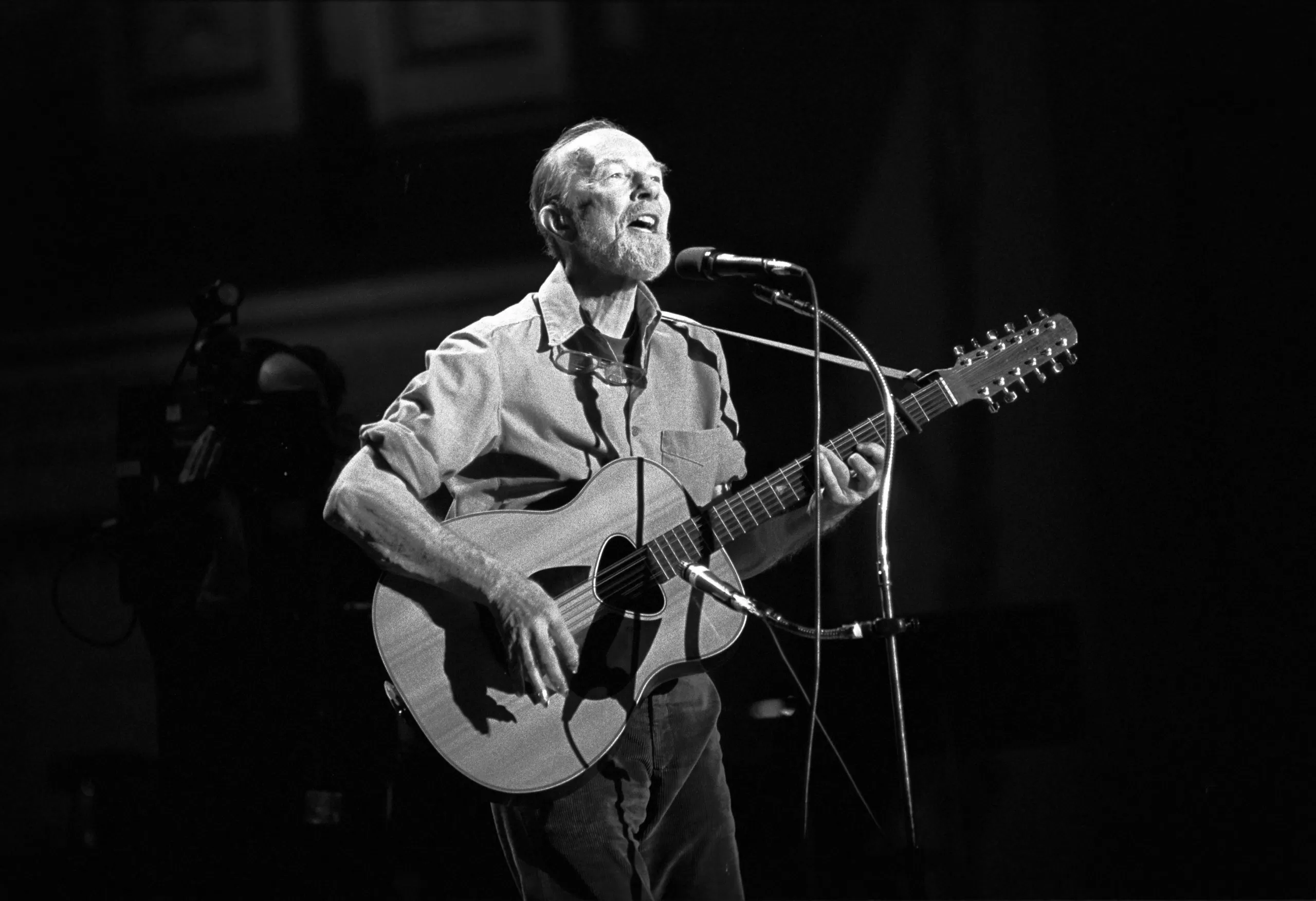
Pete Seeger, the legendary American folk singer and activist, was born on May 3, 1919. He would go on to inspire people around the country for generations with his music and his unwavering commitment to social justice. In this episode of Stories of Resistance, we take a closer look at the life and legacy of this remarkable man.
From a young age, Seeger was exposed to music and activism through his parents, who were both musicians and activists themselves. His father, Charles Seeger, was a musicologist and his mother, Constance, was a classical violinist. Growing up in a household that valued both music and social justice, it was only natural that Seeger would follow in their footsteps.
Seeger’s musical career began in the 1930s when he joined the Almanac Singers, a group of musicians who used their music to promote social and political causes. It was during this time that he met Woody Guthrie, another iconic folk singer and activist. Seeger and Guthrie would go on to collaborate on many songs, including the famous “This Land Is Your Land.”
In the 1940s, Seeger formed the influential folk group, The Weavers, with Lee Hays, Ronnie Gilbert, and Fred Hellerman. They became known for their powerful harmonies and socially conscious lyrics. However, their success was short-lived as they were blacklisted during the McCarthy era for their political beliefs. Despite this setback, Seeger continued to perform and record music, often using his platform to speak out against injustice.
Throughout his career, Seeger’s music was a powerful tool for activism. He wrote and popularized songs that became anthems for the civil rights movement, including “We Shall Overcome” and “If I Had a Hammer.” He also used his music to protest against the Vietnam War and to support environmental causes.
But Seeger’s activism was not limited to his music. He was a vocal advocate for various social and political causes, including workers’ rights, environmentalism, and nuclear disarmament. He co-founded the Clearwater organization, which works to protect the Hudson River, and was a key figure in the creation of the Newport Folk Festival, which became a platform for showcasing socially conscious music.
Seeger’s impact on American culture and society cannot be overstated. He inspired countless individuals to use their voices and talents for the greater good. His music and activism reached people from all walks of life and his message of hope and unity resonated with audiences around the world.
Even in his later years, Seeger continued to use his music as a means of resistance. In 2009, at the age of 90, he released a new album, “Tomorrow’s Children,” which featured songs about social justice and the environment. He also performed at the inauguration of President Barack Obama, singing “This Land Is Your Land” with Bruce Springsteen and other musicians.
Sadly, Seeger passed away in 2014 at the age of 94. However, his legacy lives on through his music and the countless individuals he inspired to stand up for what they believe in. He will always be remembered as a pioneer of the folk music movement and a tireless advocate for social justice.
In conclusion, Pete Seeger’s life and work are a testament to the power of music and activism. He used his talents to spread messages of hope, unity, and resistance, and his impact will continue to be felt for generations to come. As we celebrate his life and legacy on this episode of Stories of Resistance, let us be inspired by his unwavering dedication to making the world a better place through his music and his activism.

