
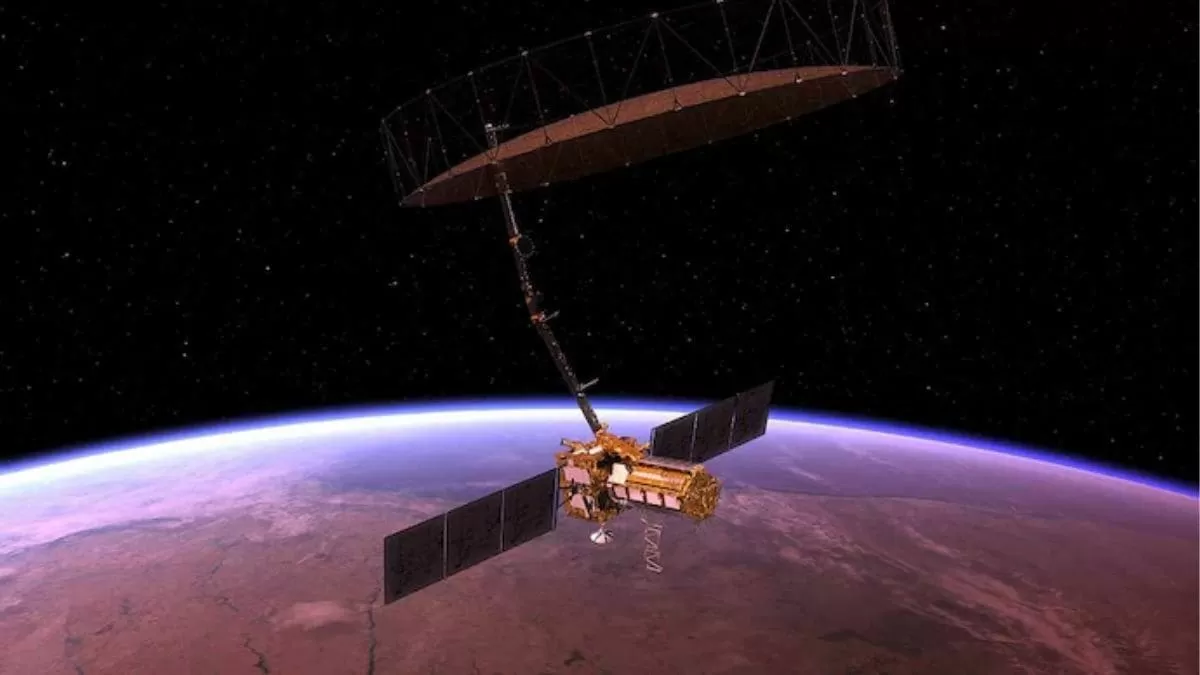
NISAR, the joint NASA-ISRO satellite mission, is set to launch in June 2025 after resolving technical issues. This highly anticipated mission will revolutionize the way we monitor and understand our planet’s surface with its advanced radar imaging capabilities.
The NASA-ISRO Synthetic Aperture Radar (NISAR) mission has been in the works for over a decade, with the two space agencies collaborating to develop the most advanced radar imaging satellite ever built. However, the project faced several setbacks, including technical challenges and budget constraints. But now, after years of hard work and dedication, NISAR is finally ready to take flight.
One of the main objectives of the NISAR mission is to study and monitor Earth’s surface with unprecedented detail and accuracy. The satellite will use advanced radar technology to create high-resolution 3D images of the planet’s surface, providing scientists with valuable data on various natural phenomena such as earthquakes, volcanoes, and landslides. This information will not only help us better understand our planet but also aid in disaster management and mitigation efforts.
The NISAR satellite will be equipped with two radar instruments, one provided by NASA and the other by ISRO. The NASA-built L-band synthetic aperture radar (SAR) will operate at a frequency of 1.27 GHz, while the ISRO-built S-band SAR will operate at 2.45 GHz. This dual-frequency radar system will allow for more accurate and detailed imaging of Earth’s surface, providing a comprehensive view of the planet’s topography, vegetation, and changes over time.
One of the most exciting aspects of the NISAR mission is its ability to measure the Earth’s surface deformation with millimeter-level precision. This will enable scientists to track changes in the Earth’s surface, such as the movement of glaciers and tectonic plates, with unprecedented accuracy. This data will be crucial in understanding the effects of climate change and predicting natural disasters.
The NISAR satellite will also play a crucial role in monitoring and managing our planet’s resources. The satellite’s radar imaging will provide valuable information on soil moisture, crop health, and water levels, helping farmers make informed decisions and improve agricultural practices. It will also aid in mapping and monitoring forests, which will be vital in preserving and protecting our planet’s biodiversity.
The NISAR mission will be a significant milestone in the collaboration between NASA and ISRO, with both agencies contributing their expertise and resources to make this mission a success. The satellite will be launched from the Satish Dhawan Space Centre in Sriharikota, India, using ISRO’s Geosynchronous Satellite Launch Vehicle (GSLV). The satellite will then be placed in a near-polar orbit, allowing it to cover the entire globe every 12 days.
The launch of NISAR was initially planned for 2022, but technical issues with the satellite’s 12-meter radar antenna caused delays. The antenna, which is crucial for capturing high-resolution images, was found to be overheating during testing. This led to a redesign of the antenna, which took some time but was necessary to ensure the success of the mission. Now, with the technical issues resolved, NISAR is ready to take flight in June 2025.
The NISAR mission is a testament to the power of international collaboration and the determination of scientists and engineers to overcome challenges and push the boundaries of space exploration. It will not only provide us with valuable data and insights into our planet but also pave the way for future joint missions between NASA and ISRO.
In conclusion, the launch of NISAR in June 2025 will mark a significant milestone in the field of remote sensing and Earth observation. The satellite’s advanced radar imaging capabilities will provide us with a deeper understanding of our planet’s surface and its changes over time. It will also aid in disaster management, resource monitoring, and scientific research, making it a crucial tool for the betterment of humanity. The successful launch of NISAR will be a proud moment for both NASA and ISRO, and we can’t wait to see what this groundbreaking mission will uncover.

