
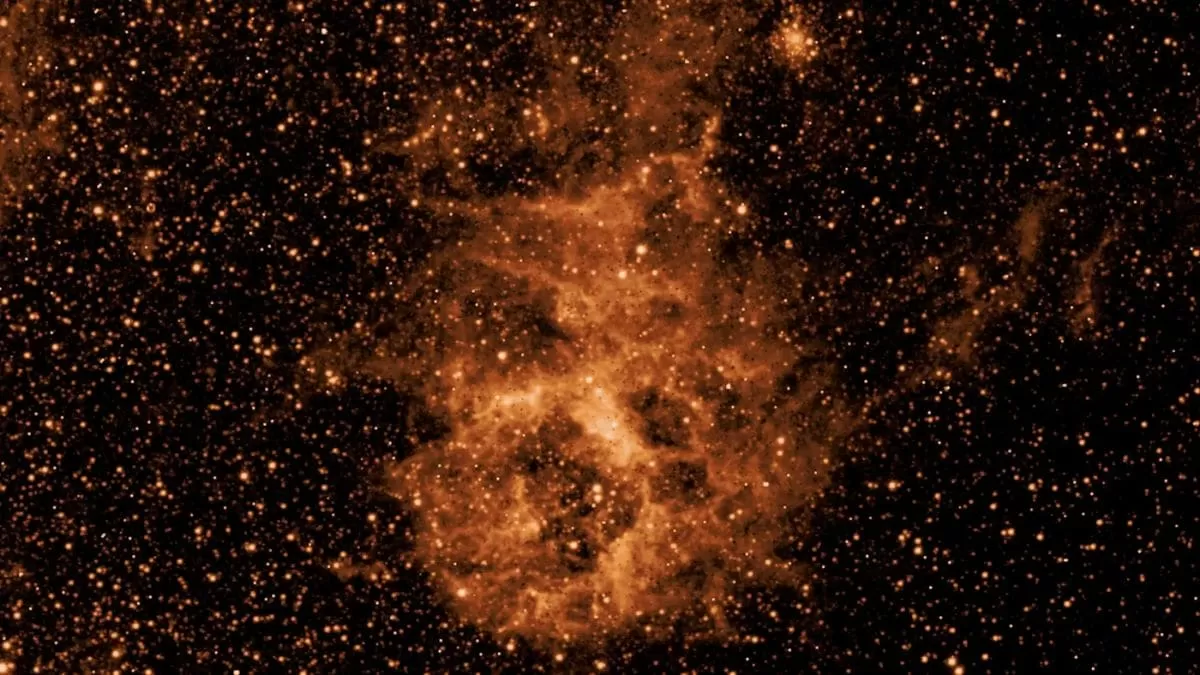
NASA’s SPHEREx space telescope has embarked on an exciting two-year mission to map the entire sky in infrared light, capturing an astonishing 3,600 images per day and covering 102 different wavelengths. This groundbreaking observatory aims to chart hundreds of millions of galaxies in 3D and unlock the secrets of the universe’s earliest moments. But that’s not all – it will also search for the presence of water and other signs of life beyond our own planet.
The SPHEREx (Spectro-Photometer for the History of the Universe, Epoch of Reionization, and Ices Explorer) mission is a joint collaboration between NASA, the Jet Propulsion Laboratory, and the California Institute of Technology. It was selected in 2019 as the fourth mission in the agency’s Explorer Program, which focuses on small, nimble spacecraft that can explore the universe in innovative ways.
This state-of-the-art telescope, equipped with powerful infrared sensors, is set to revolutionize our understanding of the cosmos. By mapping the entire sky in infrared light, SPHEREx will be able to see through dust and gas that often obscures our view of the universe. This will allow scientists to study galaxies, stars, and planets in unprecedented detail, providing a deeper understanding of the origins and evolution of our universe.
One of the main objectives of the mission is to create a 3D map of the universe, which will help us to better understand how galaxies and clusters of galaxies are distributed throughout space. By measuring the distances and movements of these celestial objects, scientists hope to gain insights into the mysterious force known as dark energy, which is believed to be responsible for the accelerating expansion of the universe.
But that’s not all – SPHEREx will also be on the lookout for water and other organic molecules in our galaxy and beyond. These molecules are crucial for the development of life as we know it, and their presence could provide valuable clues about the potential for life on other planets. By scanning the sky for these molecules, SPHEREx will help us to narrow down the search for habitable worlds in our cosmic neighborhood.
The telescope’s infrared sensors will also enable it to study the earliest moments of the universe, shortly after the Big Bang. By detecting and analyzing the faint light from the universe’s first stars and galaxies, SPHEREx will help us to understand how the universe evolved from a hot, dense state to the vast and complex cosmos we see today.
The SPHEREx mission is expected to produce an unprecedented amount of data – approximately 30 terabytes per day, which is equivalent to streaming 10,000 high-definition movies. To handle this massive amount of information, NASA has partnered with Google to develop a new data processing and analysis system. This collaboration will not only help scientists to make sense of the vast amount of data but also make it accessible to the public, allowing anyone to explore the wonders of the universe.
The space telescope is currently in the design and development phase, with a planned launch in 2024. Once in orbit, it will operate for two years, scanning the entire sky every six months. This will result in a comprehensive map of the universe, providing scientists with a wealth of new data to study for years to come.
The SPHEREx mission is a testament to NASA’s commitment to pushing the boundaries of space exploration and expanding our knowledge of the universe. With its cutting-edge technology and ambitious goals, this space telescope has the potential to transform our understanding of the cosmos and inspire future generations to reach for the stars.
As we eagerly await the launch of SPHEREx, we can only imagine the incredible discoveries that await us. This mission reminds us of the endless possibilities that lie beyond our own planet and the importance of continued exploration and discovery. With SPHEREx, the sky is no longer the limit – it’s just the beginning of our journey to unlock the mysteries of the universe.

