
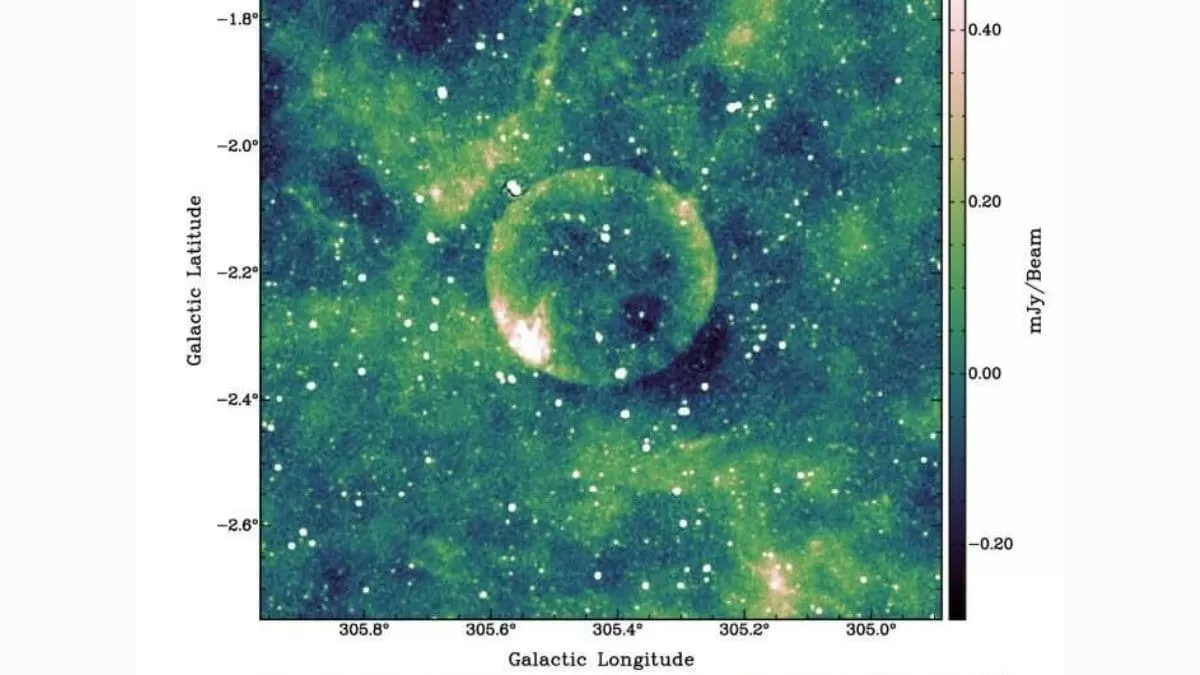
A new discovery in the vast universe has caught the attention of scientists and space enthusiasts alike. Named “Teleios,” which means “perfect” in Greek, this newly discovered supernova remnant has left scientists in awe with its rare circular symmetry.
The discovery of Teleios was made using data from ASKAP’s Evolutionary Map of the Universe. Located at G305.4–2.2, this remarkable supernova remnant could possibly be located 7,170 or 25,100 light years away from us. What makes it even more intriguing is its steep spectral index and low surface brightness, adding to its mysterious nature.
The name Teleios was given because of its perfect circular shape, something rarely seen in supernova remnants. The symmetry of this remnant has left scientists baffled, as it is not often seen in the chaotic aftermath of a supernova explosion. Its perfect shape suggests that the explosion must have occurred in a low-density environment, allowing the shockwave to expand evenly in all directions.
The discovery of Teleios is not only significant because of its unique shape, but also because it provides valuable insights into the life cycle of a supernova. A supernova is a powerful explosion that occurs at the end of a massive star’s life. As these stars run out of nuclear fuel, their cores collapse, resulting in a massive explosion that can outshine an entire galaxy for a brief period. The remnants of these explosions, like Teleios, provide a record of the star’s life and death.
The data collected from this discovery has provided scientists with a deeper understanding of the processes involved in the formation of supernovae and their remnants. It is believed that Teleios originated from a Type Ia supernova, which occurs in a binary star system. In this scenario, one star is a white dwarf, and the other is a regular star. As the white dwarf feeds off the material of its companion star, it eventually reaches a critical mass, causing a thermonuclear explosion. This explosion results in the ejection of material, forming the supernova remnant.
The unique properties of Teleios have led scientists to believe that its origin is most likely a Type Ia supernova. The steep spectral index and low surface brightness are characteristic of a Type Ia supernova remnant, further supporting this theory. However, the exact cause of the explosion and the location of the progenitor star are yet to be determined.
The discovery of Teleios is a testament to the advancements in technology and our understanding of the universe. The data from ASKAP’s Evolutionary Map of the Universe has provided us with a glimpse into the distant past, allowing us to study the remnants of a long-gone star. This discovery also highlights the importance of international collaborations and the sharing of resources and knowledge in the scientific community.
As we continue to explore and unravel the secrets of the universe, discoveries like Teleios remind us of the endless possibilities and wonders that await us. This newly discovered supernova remnant has left scientists inspired and motivated to further our understanding of the universe and the processes that shape it.
The name Teleios, meaning perfect, could not be more fitting for this extraordinary discovery. With its rare symmetry and intriguing properties, it has captivated our minds and sparked our curiosity. As we continue to study and learn from Teleios, we are reminded that there is still so much more to be discovered in the vast expanse of the universe.

