
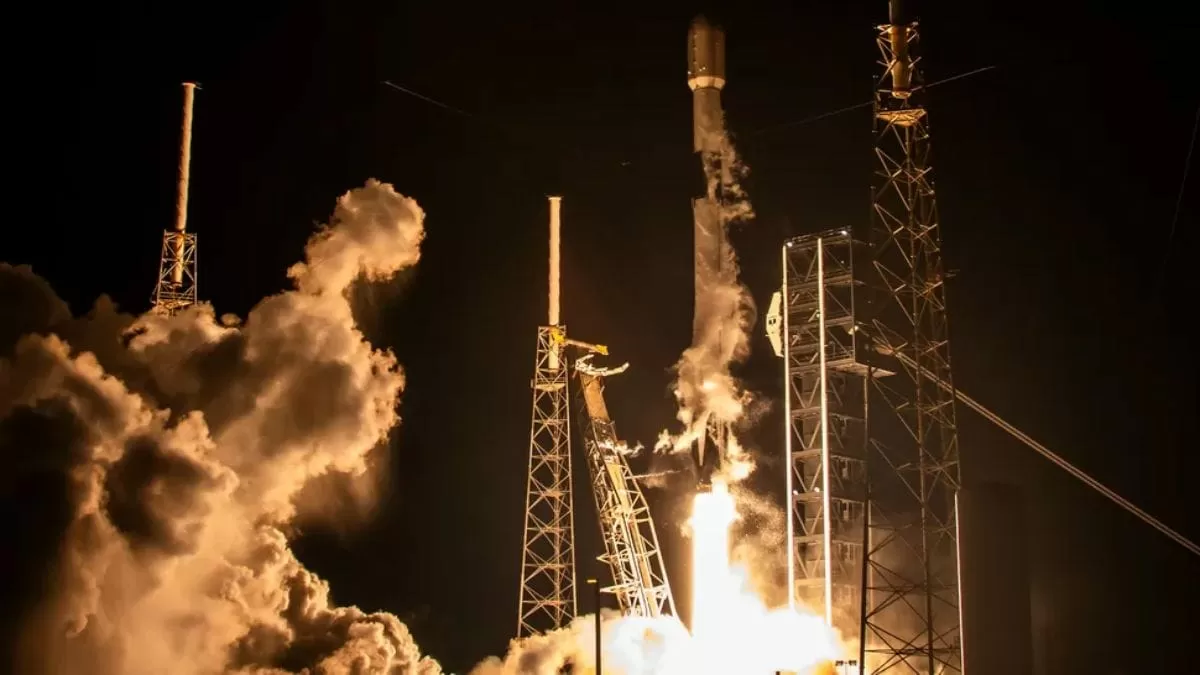
On May 20, 2025, SpaceX achieved another milestone in its journey towards revolutionizing space travel. The renowned private aerospace company successfully launched its 60th Falcon 9 mission of the year from the iconic Cape Canaveral Space Force Station in Florida. This remarkable feat was made possible by the brand-new booster, B1095, which performed flawlessly during the mission.
The rocket lifted off at 11:19 p.m. EDT from Launch Complex 40, carrying a payload of 23 Starlink V2 Mini satellites into low Earth orbit. These advanced satellites, developed by SpaceX, will play a crucial role in providing high-speed internet access to even the most remote areas of the world. However, what makes this launch even more significant is the inclusion of Direct to Cell technology on 13 of these satellites, marking a new era in satellite communications.
Direct to Cell technology, pioneered by SpaceX, is designed to provide direct connectivity from satellites to cell phones without the need for any additional ground infrastructure. This breakthrough technology has the potential to transform the way we communicate, making it faster and more reliable than ever before. With Direct to Cell, users can enjoy a seamless connection, even in areas with limited cellular coverage or during natural disasters when traditional ground-based infrastructure may be disrupted.
The successful deployment of this innovative technology on 13 Starlink satellites marks a significant step towards eliminating the digital divide and bringing high-speed internet to underserved communities. This aligns perfectly with SpaceX’s mission of making space more accessible and improving the quality of life on Earth.
The Falcon 9 rocket used in this mission is no ordinary booster. B1095 is a brand-new booster, making its maiden flight and showcasing the advanced capabilities of SpaceX’s rocket technology. It was not only able to deliver the payload into orbit but also returned to Earth, landing successfully on the “Of Course, I Still Love You” drone ship in the Atlantic Ocean. This remarkable feat highlights SpaceX’s commitment to reusable rocket technology, which significantly reduces the cost of space missions and makes them more sustainable.
The 60th Falcon 9 mission of the year is a testament to SpaceX’s impressive achievements and its future ambitions. With over 40 successful launches in just five months, SpaceX has demonstrated its ability to launch payloads on a frequent and reliable basis. This is a significant accomplishment in the space industry, where launch delays and failures are not uncommon.
Moreover, this launch also highlights the close partnership between SpaceX and the US Space Force, which operates the Cape Canaveral Space Force Station. This collaboration has been vital in facilitating frequent and efficient launches, further solidifying the US’s position as a leader in space technology.
The success of this launch is a significant step towards SpaceX’s ultimate goal of creating a global constellation of satellites that will provide high-speed internet access to the entire world. The company plans to launch thousands of Starlink satellites in the coming years, eventually creating a network that will cover every corner of the globe.
With its continuous achievements and ambitious goals, it is no surprise that SpaceX has become a household name in the space industry and has revolutionized the way we think about space. The company’s founder and CEO, Elon Musk, has constantly pushed the boundaries of innovation and disruption, making space accessible and exciting for everyone.
In conclusion, the successful launch of SpaceX’s 60th Falcon 9 mission of the year, powered by the brand-new B1095 booster, is a remarkable accomplishment that showcases the company’s capabilities and determination to change the world. The inclusion of Direct to Cell technology on 13 Starlink satellites marks a significant step towards providing high-speed internet to even the most remote areas of the world. As we look towards the future, it is certain that SpaceX will continue to push the boundaries and achieve even greater milestones, shaping the future of space travel and communication.

