
For years, scientists have been searching for clues about the early universe and the events that led to its creation. One of the most intriguing questions has been whether the universe was once filled with a hot, dense, and extremely energetic state known as quark-gluon plasma. Now, after decades of research and experimentation, physicists at CERN have finally confirmed this theory by directly observing the fluid-like behavior of this primordial soup.
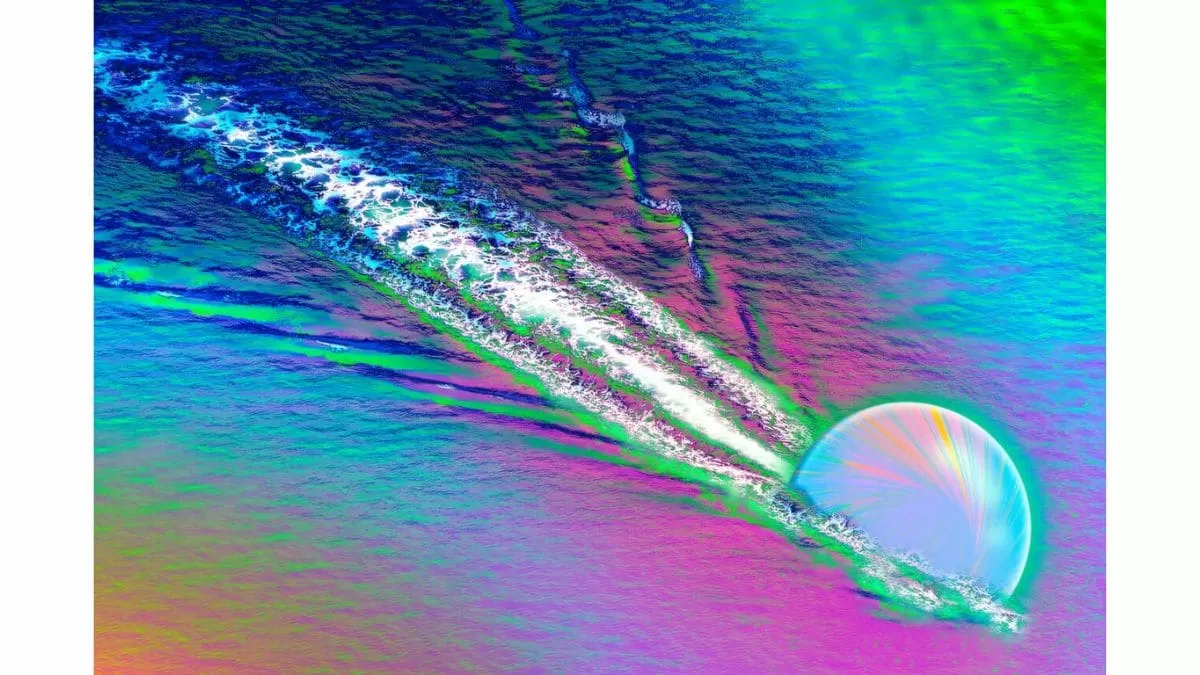
In a groundbreaking study conducted at the Large Hadron Collider (LHC), the world’s largest and most powerful particle accelerator, researchers were able to observe wake-shaped ripples forming behind fast-moving quarks in the quark-gluon plasma. These ripples are similar to the bow waves seen in liquid fluids and provide strong evidence that the early universe was indeed filled with a near-perfect, low-friction fluid shortly after the Big Bang.
The discovery, published in the journal Nature Physics, is a major breakthrough in our understanding of the early universe and confirms decades of theoretical predictions. It also sheds light on the fundamental nature of matter and the strong force that holds atomic nuclei together.
So, how did physicists at CERN manage to directly observe the elusive quark-gluon plasma? The answer lies in the incredible capabilities of the LHC. Located on the Swiss-French border, this colossal machine allows scientists to recreate the extreme conditions of the early universe by smashing together protons at near-light speeds.
Within fractions of a second after the protons collide, a tiny droplet of quark-gluon plasma is formed, lasting only a few trillionths of a second before it expands and cools down. This fleeting moment allowed researchers to observe the fluid-like behavior of the plasma and its quark wakes.
Dr. Paul Demayo, one of the lead researchers on the project, described the process as “capturing a glimpse of the universe in its infancy.” He also added that the quark-gluon plasma behaved like a perfect liquid with almost no resistance, providing strong evidence that the early universe was indeed filled with this exotic state of matter.
The confirmation of the quark-gluon plasma’s fluid-like behavior has significant implications for our understanding of the universe. It provides crucial insights into the fundamental interactions between particles and the forces that govern our world. It also supports the widely accepted theory of the Big Bang, which suggests that the universe was born from a hot, dense, and rapidly expanding state over 13 billion years ago.
Moreover, the discovery opens up new avenues for research and exploration. Scientists can now use the LHC and other advanced technologies to further study the properties and behavior of the quark-gluon plasma, providing valuable insights into the earliest moments of our universe.
The announcement of this groundbreaking discovery has been met with great excitement and enthusiasm within the scientific community. It is a testament to the hard work, dedication, and collaboration of researchers from all over the world who have been working towards this goal for decades.
With new technologies and advancements in our understanding, the possibilities for further discoveries in the field of particle physics are endless. And who knows, maybe one day we will be able to unlock the mysteries of the early universe and finally understand the origins of our existence.
In conclusion, the recent observation of the fluid-like behavior of the quark-gluon plasma by physicists at CERN is a major milestone in our understanding of the universe. It confirms the existence of this exotic state of matter and provides crucial insights into the early moments of our universe. This discovery is a testament to human curiosity, perseverance, and the power of science to unravel the mysteries of our world.

