
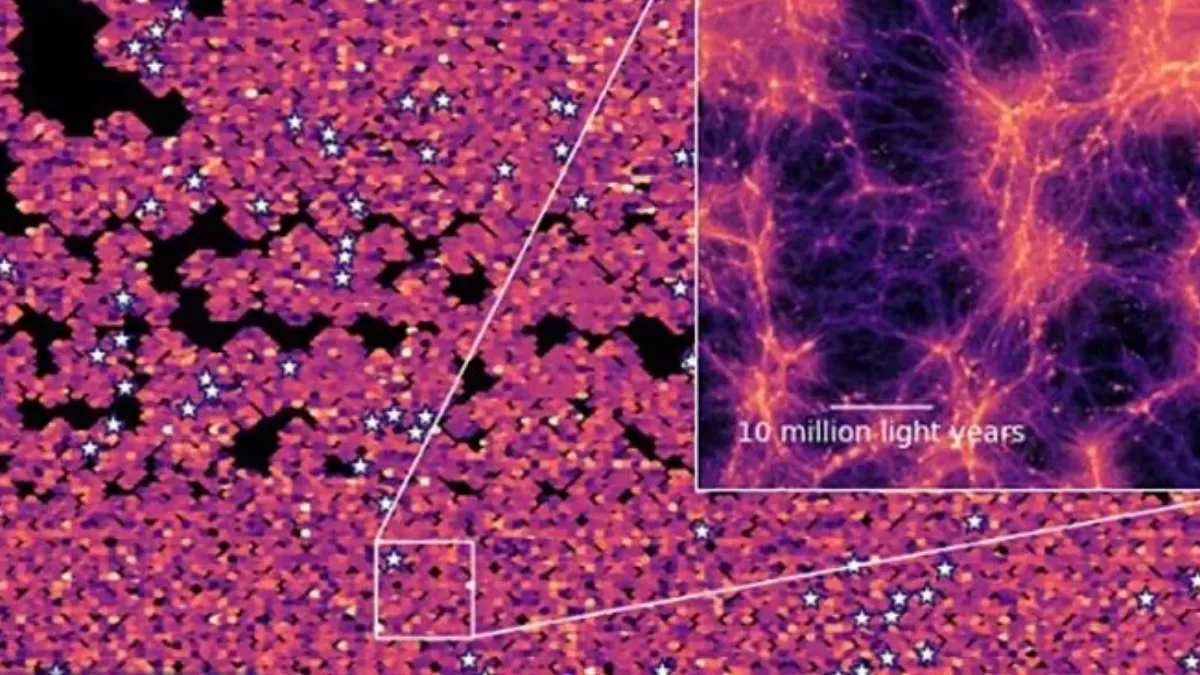
Astronomers have made an exciting discovery that sheds light on the early universe – the creation of the largest 3D map of hydrogen emission ever made. This groundbreaking map, created using data from the Hobby-Eberly Telescope Dark Energy Experiment (HETDEX), has revealed large cosmic structures that existed during the peak star-forming era of the universe, about 9-11 billion years ago.
This remarkable achievement was made possible by a team of scientists from the University of Texas at Austin, who utilized the HETDEX survey to map the distribution of hydrogen gas in the early universe. Hydrogen is the most abundant element in the universe and is crucial for the formation of stars and galaxies.
The HETDEX survey, which began in 2012, is the largest survey of its kind and aims to study the expansion of the universe and the mysterious force known as dark energy. The survey uses the 10-meter Hobby-Eberly Telescope located at the McDonald Observatory in West Texas, and has been able to capture the light from over 2 million galaxies in the early universe.
Using this vast amount of data, the team of astronomers was able to create a detailed 3D map of hydrogen emission from the early universe. This map covers an area of 1/20th of the sky and extends to a distance of 11 billion light-years, giving us a glimpse into the universe’s past.
One of the most exciting findings from this map is the discovery of large cosmic structures, including filaments and bubbles, which were formed during the peak star-forming era of the universe. These structures, which are made up of hydrogen gas, are the building blocks of galaxies and provide valuable insight into the evolution of the universe.
Dr. Steven Finkelstein, one of the lead researchers on the project, described the significance of this discovery, stating, “This map is like a time machine, allowing us to see the universe as it was billions of years ago. It’s amazing to think that we can now study the structures that gave rise to the galaxies we see today.”
The HETDEX survey has also provided valuable information about the expansion of the universe. The data collected from this survey has allowed scientists to measure the expansion rate of the universe to an accuracy of 1%, providing new insights into the mysterious force of dark energy.
This groundbreaking map has the potential to revolutionize our understanding of the early universe and its evolution. It is a testament to the incredible advancements in technology and the dedication of the scientific community to unravel the mysteries of our universe.
The HETDEX survey is ongoing, and scientists are eagerly awaiting the additional data it will provide. With this new map, astronomers will be able to study the early universe in even greater detail and gain a deeper understanding of our cosmic origins.
This incredible achievement by the team of astronomers at the University of Texas at Austin is a testament to the power of collaboration and the pursuit of scientific knowledge. It is a reminder that there is still so much to learn and discover about the vast and complex universe we live in.
So let us celebrate this monumental accomplishment and look forward to the new insights and discoveries that will come from the HETDEX survey and other groundbreaking projects in the field of astronomy. Who knows what other secrets of the universe will be revealed in the years to come? The possibilities are endless.

