
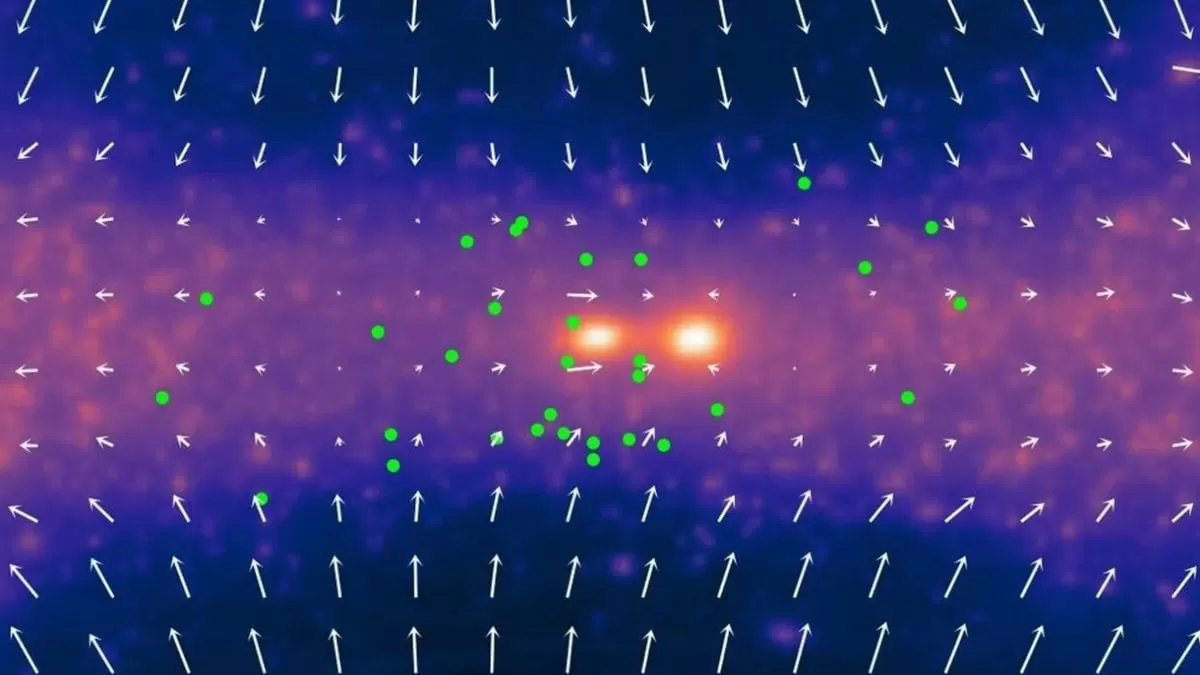
Astronomers have made a significant discovery about the structure of our galaxy, the Milky Way. After studying data from various sources, they have found that our galaxy is situated within a vast flat sheet of dark matter that stretches around 32 million light-years across. This exciting finding not only sheds light on the enigmatic dark matter but also provides an explanation for the curious movements of nearby galaxies.
The existence of dark matter has long been a topic of fascination and debate among astronomers. It is a mysterious, invisible substance that makes up nearly 85% of the universe’s mass. Despite its prevalence, it has never been directly observed, and its exact nature remains a mystery. However, using data from the European Space Agency’s Gaia satellite and the Sloan Digital Sky Survey, researchers have been able to map the distribution of dark matter around the Milky Way.
Their findings, published in the journal Nature Astronomy, reveal that our galaxy is situated within a massive flat sheet of dark matter. This sheet is estimated to be around 32 million light-years across and approximately 1.5 million light-years thick. This structure is much more extensive and flatter than previously thought and provides new insights into the structure of the universe.
The researchers also found that this sheet is surrounded by vast cosmic voids, which are areas devoid of any significant matter. These voids are essential as they balance the gravitational forces acting on the Milky Way and other nearby galaxies. This balance of gravitational forces is why most galaxies, including our own, move away from each other instead of falling towards the Local Group, a cluster of galaxies that includes the Milky Way and Andromeda galaxies.
To understand this phenomenon better, the researchers developed computer simulations that mimic the formation of the universe. These simulations showed that the massive dark matter sheet, along with the cosmic voids, acts as a bungee cord. It provides the necessary tension and balance to counteract the pull of gravity and keep galaxies from collapsing in on each other.
This discovery is not only a breakthrough in understanding the mysterious nature of dark matter, but it also provides an explanation for the movement of galaxies in our local neighborhood. It also adds to our understanding of the larger structure of the universe, with its vast sheets of dark matter and cosmic voids.
Dr. Alis Deason, one of the lead researchers of the study, said, “We were amazed to discover that such an incredibly thin structure exists, especially when considering the vast distances involved. We have known for a while that there is a dark matter halo around our galaxy, but to find it in such an organized and extensive sheet is truly remarkable.”
This finding is also significant because it provides new insights into the role of dark matter in galaxy formation. Dark matter is believed to play a crucial role in the formation of galaxies, and the discovery of this vast sheet of dark matter provides further evidence of its influence.
The study also has implications for future research in the field of astronomy. As we continue to map the distribution of dark matter, we may uncover more of these massive sheets and further our understanding of the universe’s structure.
The discovery of this massive sheet of dark matter and its role in shaping the movements of nearby galaxies is an exciting development in the field of astronomy. It not only deepens our understanding of the universe but also raises new questions and avenues for research. As we continue to unravel the mysteries of the universe, this discovery serves as a reminder of how much more we have yet to discover.

