
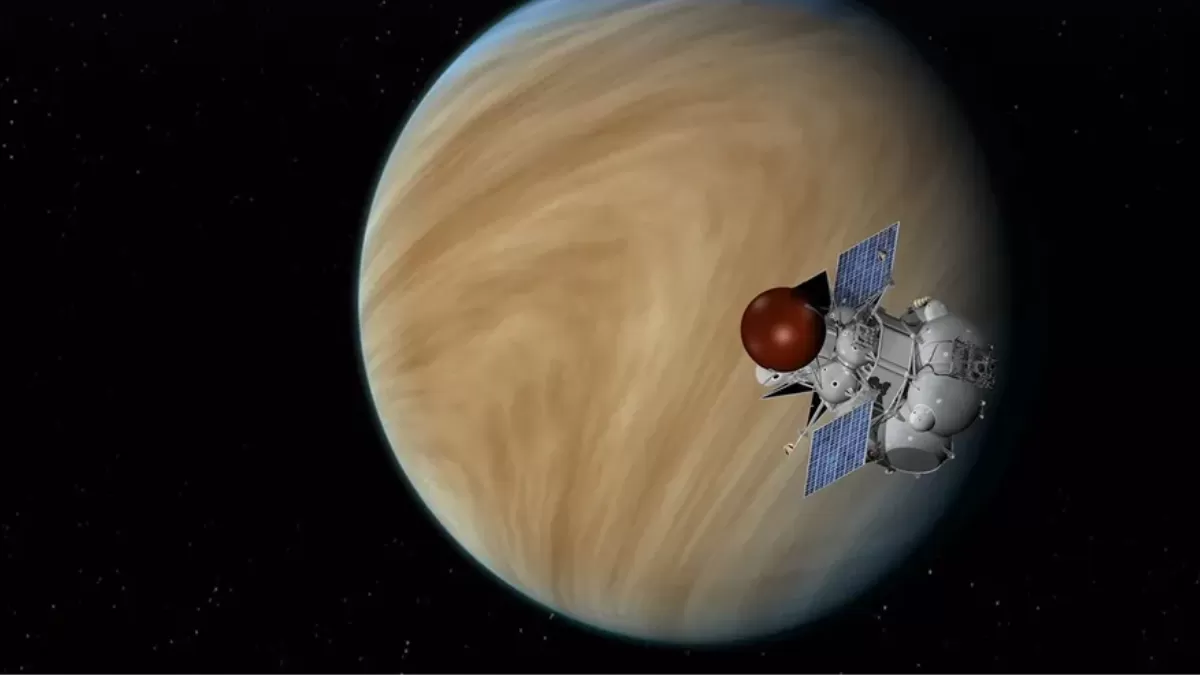
Russia has announced its plans to launch the Venera-D mission to Venus in 2036, marking a significant step in the exploration of our neighboring planet. The mission, which will include an orbiter, balloon probe, and lander, aims to study Venus’s atmosphere, clouds, and surface, while also searching for possible microbial life. This ambitious project will continue the legacy of Soviet Venus exploration and could potentially uncover groundbreaking discoveries about the planet.
The Venera-D mission is a joint effort between the Russian Space Research Institute and the Russian Academy of Sciences, with contributions from various international partners. It is named after the Venera program, a series of Soviet missions that successfully landed probes on Venus in the 1960s and 1970s. These missions provided valuable data and images of the planet, but due to technological limitations, they were unable to fully explore and understand Venus’s complex environment.
However, with advancements in technology and knowledge gained from previous missions, the Venera-D mission is set to be the most comprehensive and advanced mission to Venus to date. The orbiter, which will be equipped with a suite of instruments, will study the planet’s atmosphere, its composition, and dynamics. This will provide crucial insights into the extreme conditions on Venus, including its thick, toxic atmosphere and intense greenhouse effect.
The balloon probe, named Vega, will be released from the orbiter and will float through the planet’s atmosphere, collecting data on its composition, temperature, and pressure. This will allow scientists to better understand the atmospheric processes on Venus and how they contribute to its extreme climate. The probe will also carry a small camera, providing stunning images of the planet’s clouds and surface.
The lander, named Venera-D, will be the first spacecraft to touch down on Venus’s surface since the Soviet Venera missions in the 1980s. It will carry a suite of instruments to study the planet’s surface, including a seismometer to detect any seismic activity and a drill to collect samples from the surface. This will provide valuable information about the geological history of Venus and could potentially uncover evidence of past or present microbial life.
One of the main objectives of the Venera-D mission is to search for signs of microbial life on Venus. While the planet’s harsh conditions make it unlikely for complex life forms to exist, scientists believe that microbial life may have adapted to survive in the extreme environment. The mission will focus on areas of the planet that may have once been habitable, such as the highlands and the edges of the planet’s vast lava plains.
The Venera-D mission also aims to answer some of the long-standing mysteries surrounding Venus. Despite being similar in size and composition to Earth, Venus has a vastly different environment, with surface temperatures hot enough to melt lead and atmospheric pressures 90 times that of Earth. The mission will provide crucial data to better understand the planet’s evolution and how it became the inhospitable world it is today.
The launch of the Venera-D mission is scheduled for 2036, with the spacecraft expected to reach Venus in 2037. The mission will have a duration of 3-4 years, during which it will collect and transmit data back to Earth. This data will not only expand our knowledge of Venus but also provide valuable insights into the formation and evolution of terrestrial planets in our solar system and beyond.
The Venera-D mission is a testament to the determination and expertise of the Russian space program. It represents a significant milestone in the exploration of Venus and is a testament to the country’s rich history and legacy in space exploration. The mission has the potential to uncover groundbreaking discoveries and inspire future generations to continue pushing the boundaries of space exploration.
In conclusion, the Venera-D mission to Venus is an ambitious and exciting project that will continue the legacy of Soviet Venus exploration and potentially uncover groundbreaking discoveries about our neighboring planet. With advanced technology and international collaboration, this mission has the potential to revolutionize our understanding of Venus and provide valuable insights into the formation and evolution of our solar system. We eagerly await the launch of the Venera-D mission in 2036 and the discoveries it will bring.

