
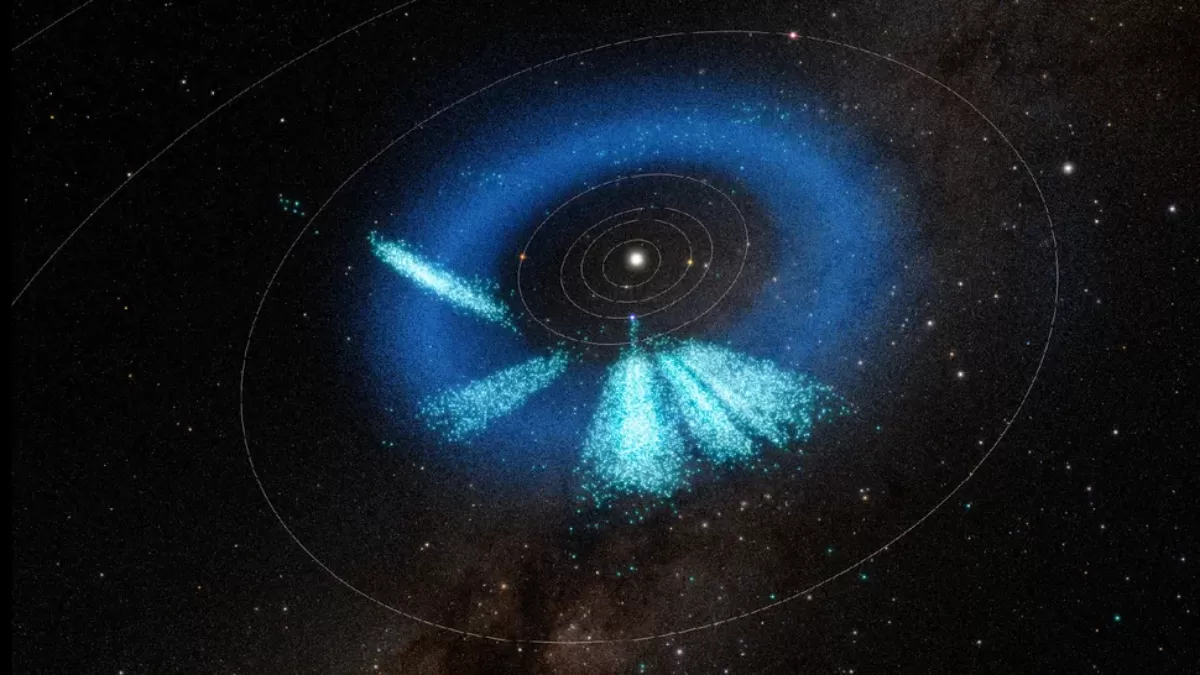
The Vera Rubin Observatory, located in Chile, has made a groundbreaking discovery in the field of astronomy. In just a matter of weeks, the observatory has identified over 11,000 new asteroids, showcasing its remarkable ability to rapidly map the solar system. This achievement not only adds to our understanding of the universe but also has significant implications for planetary defense.
The Vera Rubin Observatory, formerly known as the Large Synoptic Survey Telescope (LSST), is a state-of-the-art facility designed to scan the entire sky every few nights. Its main goal is to create a comprehensive map of the universe, providing valuable insights into the mysteries of space. However, the observatory’s capabilities go beyond just mapping the stars. Its advanced technology allows it to detect and track near-Earth objects (NEOs), such as asteroids, with unprecedented speed and accuracy.
In the early stages of its operations, the Vera Rubin Observatory has already surpassed expectations. Within just a few weeks of its initial observations, it has discovered over 11,000 new asteroids. This is a remarkable feat, considering that it took previous surveys years to identify a similar number of asteroids. The observatory’s rapid mapping of the solar system has opened up new possibilities for studying and understanding these celestial bodies.
One of the most significant implications of this discovery is the improved tracking of NEOs. With the increasing number of asteroids being identified, the Vera Rubin Observatory is playing a crucial role in planetary defense. These asteroids, if left undetected, could potentially pose a threat to Earth. By accurately tracking their movements, scientists can predict their trajectories and take necessary measures to protect our planet.
The Vera Rubin Observatory’s findings have also shed light on the distribution of asteroids in our solar system. It has revealed that there are more asteroids in the inner solar system than previously thought. This information is vital for understanding the formation and evolution of our solar system. It also provides valuable insights into the potential sources of water and other resources on these asteroids, which could be crucial for future space exploration missions.
Moreover, the observatory’s ability to rapidly map the solar system has opened up new opportunities for scientific research. With its powerful telescope and advanced technology, it can capture images of the sky with unprecedented detail. This will allow scientists to study the properties and characteristics of these newly discovered asteroids, providing valuable insights into their composition and origins.
The Vera Rubin Observatory’s success is a testament to the power of technology and human curiosity. Its advanced capabilities have enabled it to achieve what was once thought to be impossible. This achievement has not only advanced our understanding of the universe but also has significant implications for our planet’s safety.
The observatory’s success has also sparked excitement and enthusiasm among the scientific community. It has set a new standard for future astronomical surveys and has opened up new possibilities for studying the universe. The data collected by the Vera Rubin Observatory will be made available to the public, allowing amateur astronomers and citizen scientists to contribute to the research and make new discoveries.
In conclusion, the Vera Rubin Observatory’s discovery of over 11,000 new asteroids within weeks of its early observations is a remarkable achievement. It highlights the observatory’s ability to rapidly map the solar system and improve tracking of near-Earth objects for planetary defense. This groundbreaking discovery has not only advanced our understanding of the universe but also has significant implications for the safety of our planet. The Vera Rubin Observatory has set a new standard for astronomical surveys and has opened up new possibilities for scientific research. It is a testament to human ingenuity and our endless quest to unravel the mysteries of the universe.

