
Scientists have long been fascinated by the vast and mysterious universe that surrounds us. With each new discovery, we gain a deeper understanding of the complexities and wonders of our universe. Recently, a team of scientists has made a groundbreaking discovery that could reshape our understanding of planetary systems and the formation of moons.
The team, led by Dr. Xianyu Tan of the University of Florida, has found evidence that suggests the strong magnetic field of Jupiter played a crucial role in the formation of multiple large moons around the gas giant. This finding is significant as it challenges the current understanding of how moons are formed and could have implications for the search for exomoons in distant planetary systems.
Jupiter, the largest planet in our solar system, is known for its strong magnetic field, which is about 20,000 times stronger than Earth’s. This magnetic field creates a protective shield around the planet, deflecting harmful solar winds and radiation. But according to Dr. Tan’s team, this magnetic field also played a crucial role in creating regions for multiple large moons to form around Jupiter.
The team used computer simulations to study the formation of moons around Jupiter and Saturn, the two gas giants in our solar system with the most significant number of moons. They found that while Saturn’s weaker magnetic field allowed for the formation of a few large moons, Jupiter’s strong magnetic field created regions where multiple large moons could form.
This finding is significant as it challenges the current understanding of how moons are formed. According to the traditional theory, moons are formed when a planet’s gravity pulls in debris from the surrounding space. However, this theory cannot explain the formation of multiple large moons around Jupiter, as the debris would have been scattered by the planet’s strong magnetic field.
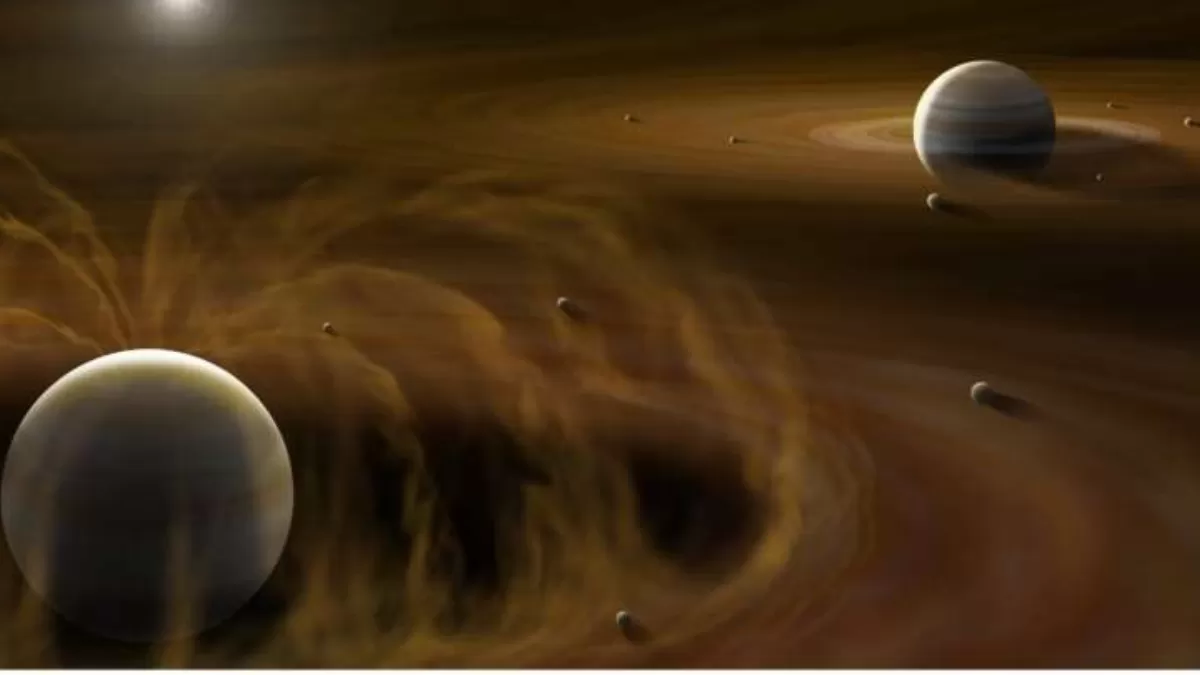
Dr. Tan’s team suggests that the strong magnetic field of Jupiter created a disk of gas and dust around the planet, similar to the one that formed the planets in our solar system. This disk provided the necessary material for the formation of multiple large moons. The team’s simulations also showed that the moons formed in a specific pattern, with the largest moon forming closest to the planet and the smaller moons forming further away.
This finding has significant implications for the search for exomoons in distant planetary systems. Exomoons, or moons orbiting planets outside our solar system, have been a topic of great interest for astronomers. However, the traditional theory of moon formation could not explain the presence of multiple large moons around gas giants in other planetary systems. Dr. Tan’s team’s findings suggest that the presence of a strong magnetic field could be a crucial factor in the formation of exomoons.
The team’s research has been published in the journal Nature Astronomy, and it has already garnered attention from the scientific community. Dr. Tan believes that this discovery could lead to a new understanding of how moons are formed and could even help us identify potential exomoons in other planetary systems.
This groundbreaking discovery is a testament to the power of scientific research and the endless possibilities that lie within our universe. It reminds us that there is still so much to learn and discover, and each new finding brings us closer to unraveling the mysteries of our universe.
As we continue to explore and study the vastness of space, we are constantly reminded of the wonders and complexities of our universe. The discovery of the role of Jupiter’s strong magnetic field in the formation of multiple large moons is just one example of how our understanding of the universe is constantly evolving. Who knows what other secrets and mysteries await us in the depths of space?

