
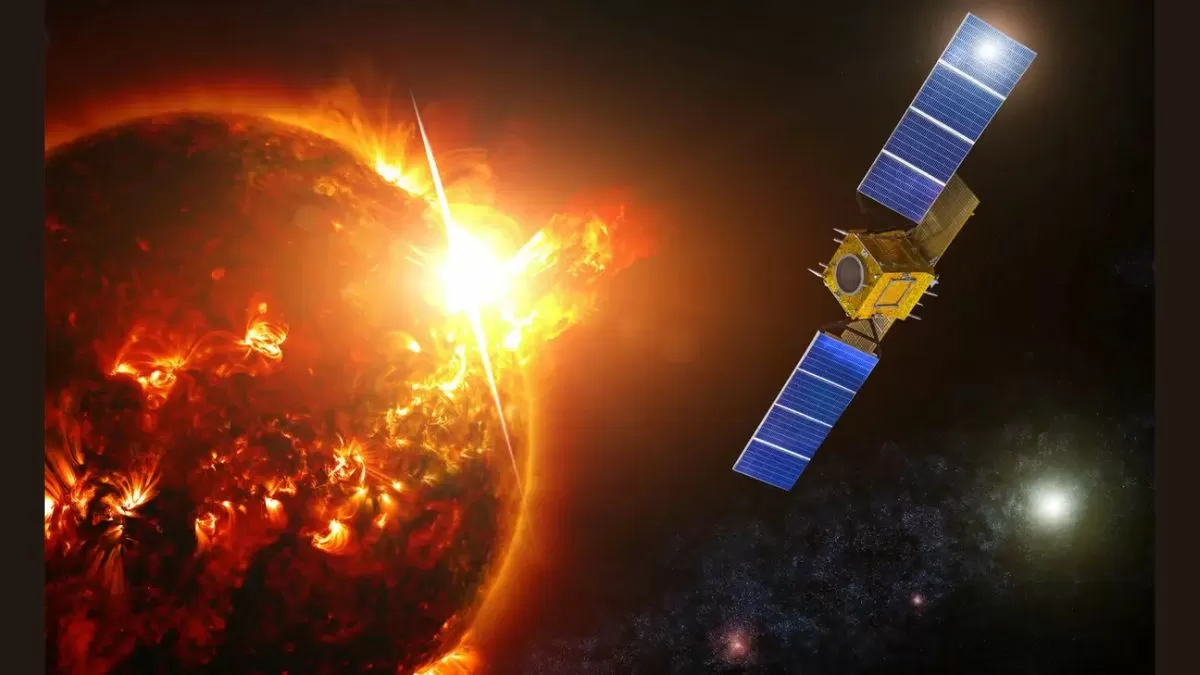
ESA’s Solar Orbiter, a joint mission between the European Space Agency (ESA) and NASA, has once again captured a remarkable phenomenon in our solar system. On October 12, 2022, the spacecraft recorded a giant plasma structure extending millions of kilometres from the Sun’s surface. This footage has left scientists in awe and has opened up new possibilities for understanding the dynamics of our Sun.
The Solar Orbiter, launched in February 2020, is on a mission to study the Sun and its influence on the solar system. Equipped with state-of-the-art instruments, the spacecraft has been sending back valuable data and images of the Sun, providing us with a deeper understanding of our closest star.
The recent footage captured by the Solar Orbiter shows a swirling motion in the solar wind, a phenomenon never observed before. This swirling motion is caused by a pseudostreamer, a large-scale structure in the solar wind, which is formed due to a solar flare near the Sun’s north pole. This is the first time a pseudostreamer has been observed in such detail, thanks to the Solar Orbiter’s close proximity to the Sun.
The plasma structure, which lasted for several hours, was recorded by the spacecraft’s Extreme Ultraviolet Imager (EUI) and the Solar Orbiter Heliospheric Imager (SoloHI). These instruments were specifically designed to capture high-resolution images of the Sun’s atmosphere and its surroundings.
The footage shows the pseudostreamer extending millions of kilometres from the Sun’s surface, with a swirling motion that resembles a tornado. This structure is made up of hot plasma, which is constantly flowing outwards from the Sun. The solar wind, which is a stream of charged particles, is responsible for creating this plasma structure. The swirling motion is caused by the interaction between the solar wind and the Sun’s magnetic field.
Scientists are excited about this discovery as it provides a new perspective on the dynamics of the Sun. Pseudostreamers are known to be a source of fast solar wind, which can have a significant impact on space weather. Space weather refers to the conditions in space that can affect satellites, communication systems, and even power grids on Earth. By studying these structures, scientists can better understand and predict space weather, which is crucial for the safety of our technology and astronauts in space.
The Solar Orbiter’s close proximity to the Sun has allowed scientists to study the pseudostreamer in unprecedented detail. This has provided valuable insights into the structure and behavior of these large-scale structures in the solar wind. It has also given scientists a better understanding of the Sun’s magnetic field and its influence on the solar wind.
This discovery is just one of the many achievements of the Solar Orbiter mission. The spacecraft has already provided us with stunning images of the Sun’s surface, including the first-ever images of the Sun’s poles. It has also captured solar eruptions and coronal mass ejections, which are powerful bursts of energy and particles from the Sun.
The Solar Orbiter is expected to continue its mission for the next seven years, providing us with more groundbreaking discoveries and insights into our Sun. The data and images sent back by the spacecraft will be studied by scientists around the world, helping us to unravel the mysteries of our closest star.
This latest discovery by the Solar Orbiter is a testament to the power of collaboration and the advancements in technology. The joint effort between ESA and NASA has once again proven to be fruitful, pushing the boundaries of our knowledge and understanding of the universe.
As we continue to explore and study our solar system, we are constantly reminded of the vastness and complexity of the universe. The Solar Orbiter’s footage of the giant plasma structure is a reminder of the wonders that await us in space and the endless possibilities for discovery and advancement.
In conclusion, the Solar Orbiter’s recording of the pseudostreamer is a significant milestone in our understanding of the Sun and its influence on our solar system. This discovery has opened up new avenues for research and has provided us with a deeper understanding of the dynamics of our closest star. As we eagerly await more data and images from the Solar Orbiter, we can only imagine what other wonders and mysteries it will uncover in the years to come.

