
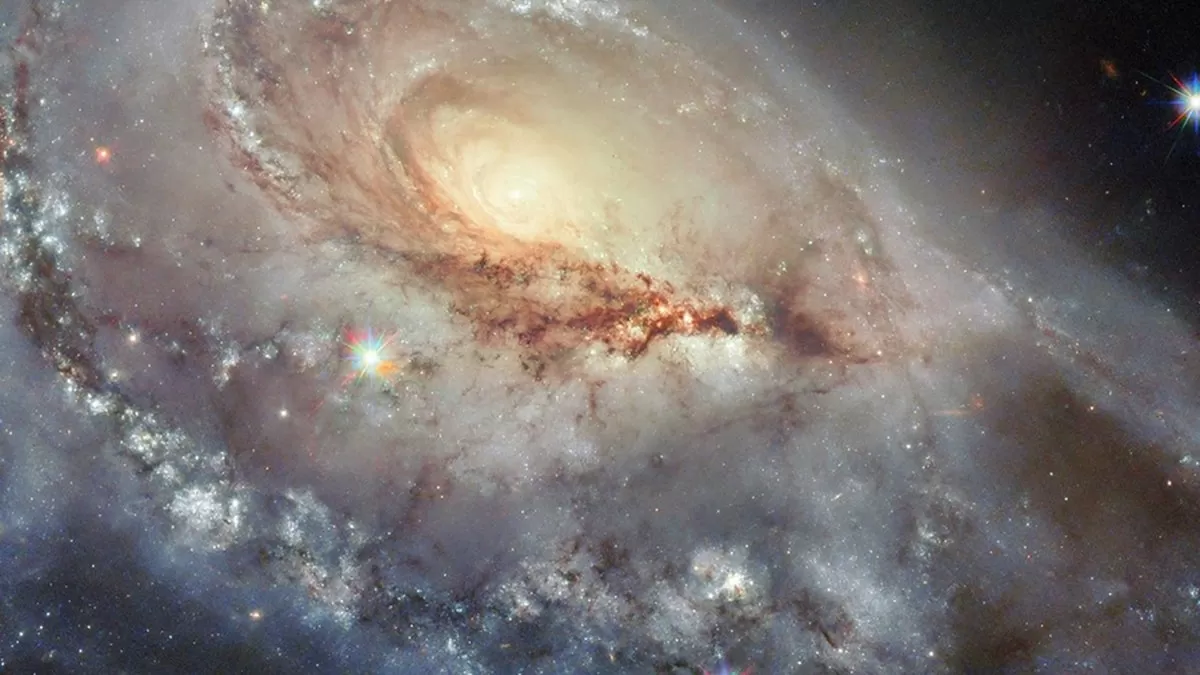
Arp 184, also known as NGC 1961, is a captivating spiral galaxy that has been captured by NASA/ESA’s Hubble Space Telescope. This stunning yet asymmetrical galaxy is located approximately 190 million light-years away in the Camelopardalis constellation. With its single, starry spiral arm and a rich history of supernovae, Arp 184 has fascinated astronomers and space enthusiasts alike. It has also earned a place in Halton Arp’s famous Atlas of Peculiar Galaxies, due to its unique and intriguing characteristics.
The first thing that catches the eye when looking at Arp 184 is its irregular shape. Unlike most spiral galaxies, which have symmetrical and evenly distributed arms, Arp 184 has a single, sweeping arm that spirals out from its center. This asymmetry is believed to be caused by a past interaction with another galaxy, which has left its mark on Arp 184. This encounter has caused the galaxy’s gas and stars to be pulled in a particular direction, creating its distinct shape.
Despite its irregular appearance, Arp 184 is a sight to behold. Its spiral arm is littered with bright, young stars, giving it a vibrant and starry appearance. The galaxy’s center is also filled with a dense concentration of stars, which can be seen in the Hubble Space Telescope’s stunning images. These stars have been formed from the gas and dust that have been pulled in by the galaxy’s gravitational pull, and their dazzling display is a testament to the beauty of the universe.
Another interesting aspect of Arp 184 is its rich history of supernovae. These are massive explosions that occur at the end of a star’s life cycle, and they can outshine entire galaxies for a brief period. Arp 184 has had several supernovae events in its past, with the most recent one occurring in 2001. These events are crucial for astronomers, as they provide valuable insight into the life cycles of stars and the evolution of galaxies.
Arp 184’s unique characteristics have made it a subject of interest for astronomers for many years. In the 1960s, American astronomer Halton Arp included the galaxy in his Atlas of Peculiar Galaxies, which showcases galaxies with unusual or peculiar features. Arp 184 stands out in this atlas due to its irregular shape and asymmetrical spiral arm, making it a fascinating subject for scientific study.
Despite its distance from Earth, Arp 184 has been extensively studied by various telescopes, including the Hubble Space Telescope. These observations have given astronomers a better understanding of the galaxy’s properties and its evolution over time. By studying galaxies like Arp 184, scientists can gain valuable insights into the formation and evolution of the universe.
In conclusion, Arp 184, also known as NGC 1961, is a beautiful and captivating spiral galaxy located in the Camelopardalis constellation. Its single, starry spiral arm and rich history of supernovae make it a unique and intriguing subject for astronomers. With its inclusion in the Atlas of Peculiar Galaxies and its extensive study by various telescopes, Arp 184 has cemented its place as a remarkable and fascinating galaxy. As we continue to explore and discover the wonders of the universe, galaxies like Arp 184 will continue to amaze and inspire us.

