
NASA’s IXPE satellite has made a groundbreaking discovery that may finally solve one of the biggest mysteries in astrophysics. For years, scientists have been trying to understand how X-rays are produced in the extreme jets of supermassive black holes. And now, thanks to the observations of the blazar BL Lacertae, IXPE has confirmed the role of Compton scattering in this process.
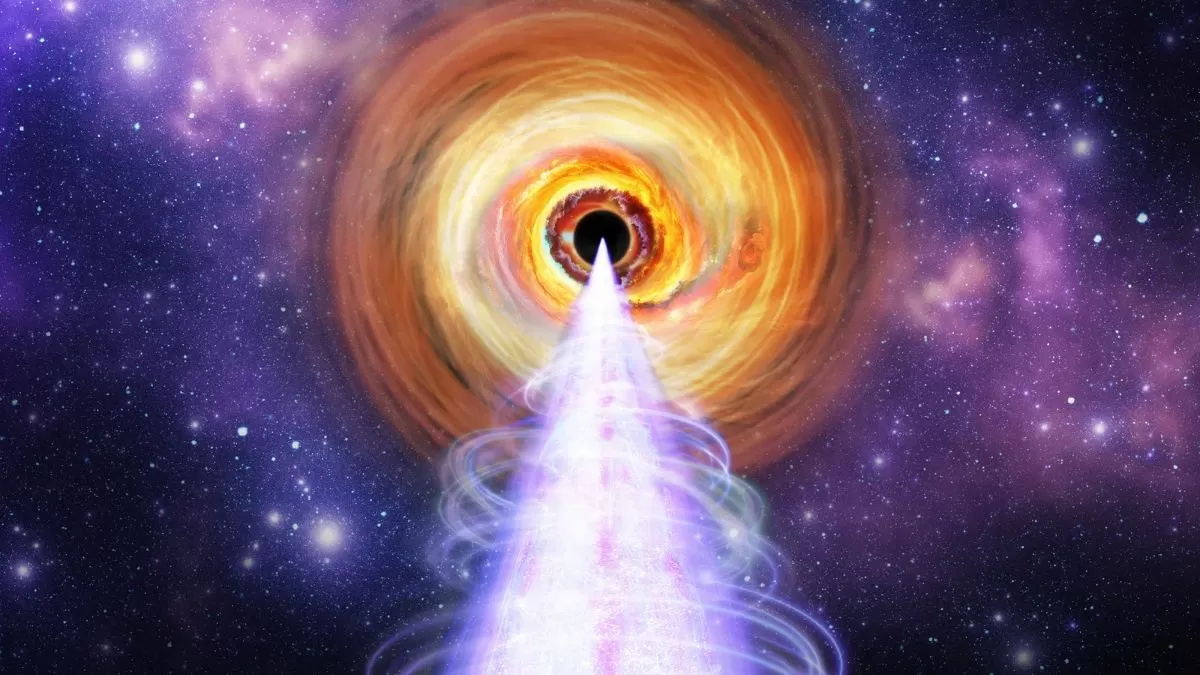
The blazar BL Lacertae, located 950 million light-years away from Earth, is a type of active galaxy with a supermassive black hole at its center. This black hole is surrounded by a disk of hot gas and dust, which is constantly being fed by material from its surroundings. As this material falls towards the black hole, it forms powerful jets that shoot out into space at nearly the speed of light.
These jets emit a wide range of electromagnetic radiation, including X-rays and optical light. However, the source of these X-rays has long been a mystery. Scientists have proposed various theories, but none have been able to fully explain the observations. That is, until now.
NASA’s Imaging X-ray Polarimetry Explorer (IXPE) satellite, launched in June 2019, was specifically designed to study the polarization of X-rays from cosmic sources. Polarization is the orientation of the electric and magnetic fields of a light wave, and it can provide valuable information about the physical processes at work in the source of the radiation.
In the case of BL Lacertae, IXPE’s observations revealed something unexpected. While the optical light from the blazar showed a very high level of polarization, the X-rays showed a much lower level. This stark contrast between the two forms of radiation was a crucial clue in solving the mystery of X-ray production in supermassive black hole jets.
According to the team of scientists involved in the study, this difference in polarization can be explained by Compton scattering. This is a process where high-energy photons (such as X-rays) collide with low-energy electrons, resulting in a change in the direction of the photons. This process is known to occur in the extreme environments around supermassive black holes, and it can produce X-rays with a lower level of polarization.
This breakthrough discovery not only provides an explanation for the source of X-rays in supermassive black hole jets, but it also confirms the role of Compton scattering in this process. This is a significant step forward in our understanding of the physical processes at work in these extreme environments.
But why is this discovery so important? Understanding the production of X-rays in supermassive black hole jets can provide valuable insights into the behavior of these powerful objects. It can also help us to better understand the structure and dynamics of the jets themselves, which can have a significant impact on the surrounding galaxy.
Moreover, this discovery has broader implications for astrophysics as a whole. Compton scattering is a fundamental process that occurs in a wide range of cosmic sources, from active galaxies to gamma-ray bursts. By confirming its role in the production of X-rays in supermassive black hole jets, we can now apply this knowledge to other cosmic phenomena and gain a deeper understanding of the universe.
The success of IXPE’s observations also highlights the importance of continued investment in space exploration and scientific research. NASA’s satellite missions, such as IXPE, play a crucial role in expanding our knowledge of the universe and pushing the boundaries of human understanding.
In addition to the scientific breakthrough, the success of IXPE’s observations also serves as a testament to the power of collaboration. The study involved scientists from NASA, the Italian Space Agency (ASI), and the Italian National Institute for Astrophysics (INAF). This collaboration not only brought together different expertise and resources, but it also fostered a spirit of international cooperation and unity in the pursuit of scientific knowledge.
In conclusion, NASA’s IXPE satellite has made a groundbreaking discovery that may finally solve the mystery of X-ray production in supermassive black hole jets. By observing the blazar BL Lacertae, IXPE has confirmed the role of Compton scattering in this process, providing valuable insights into the physical processes at work in these extreme environments. This breakthrough not only expands our understanding of the universe, but it also highlights the importance of continued investment in space exploration and international collaboration in scientific research. The future looks bright for astrophysics, and we can’t wait to see what other mysteries will be unraveled by NASA’s cutting-edge technology.

