
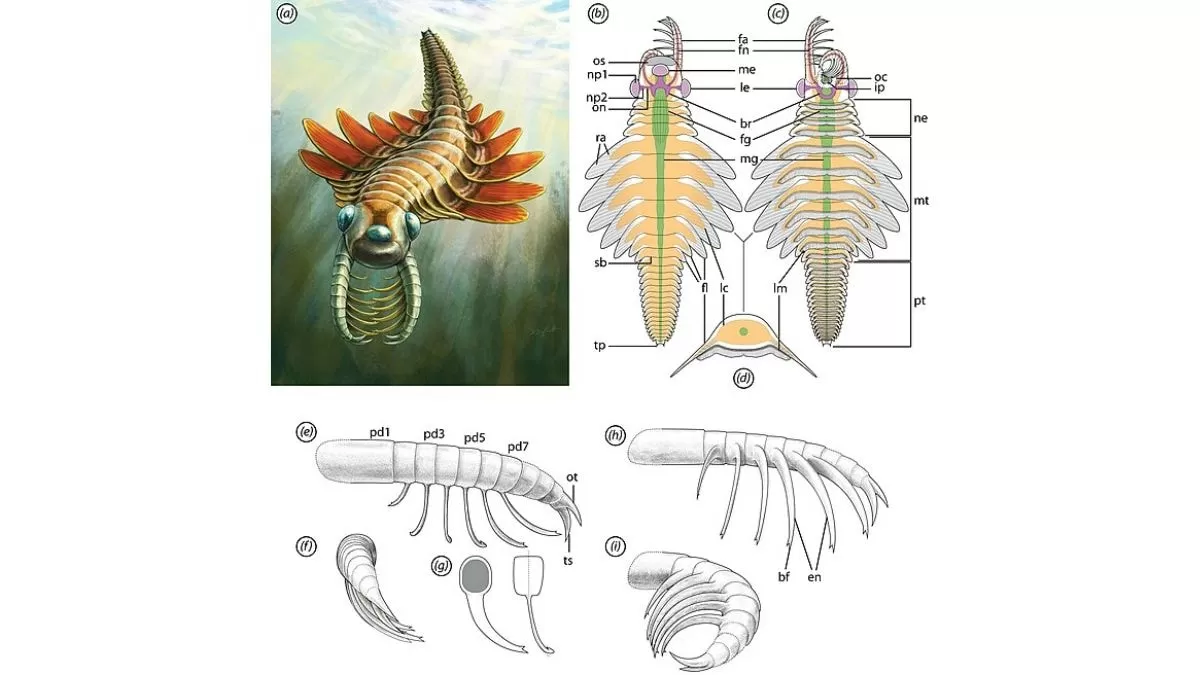
Paleontology is a field that never ceases to amaze us. Just when we think we have discovered all there is to know about the ancient creatures that once roamed our planet, a new discovery is made that challenges our understanding of the past. Recently, paleontologists have made an incredible discovery in the fossil collections of Canada’s museums – the Mosura fentoni.
Named after the iconic Japanese monster Mothra, this three-eyed, finger-sized marine predator lived half a billion years ago during the Cambrian period. Its existence has been revealed through a detailed examination of fossil specimens found in various museum collections across Canada. This discovery has provided us with a rare opportunity to learn more about the evolution of marine life during this time period.
The Mosura fentoni belongs to a group of ancient arthropods known as radiodonts. These creatures were among the largest predators of the Cambrian seas, with some species growing up to 2 meters in length. However, the Mosura fentoni was much smaller, measuring only a few centimeters in length. Despite its diminutive size, this ancient predator was no less fascinating.
What makes the Mosura fentoni so unique is its highly segmented body, which is divided into multiple sections. This characteristic is not typically seen in other radiodonts, making it a significant find for paleontologists. The segmented body of the Mosura fentoni was likely an adaptation for efficient movement and hunting in the water.
But perhaps the most intriguing feature of this ancient creature is its unusually long gills on its rear. These gills were much longer than those of other radiodonts, leading scientists to believe that they may have been adapted for breathing in low-oxygen environments. This is a significant discovery as it sheds light on the environmental conditions of the Cambrian seas and how creatures adapted to survive in them.
The Mosura fentoni also had three eyes, with the third eye located on the top of its head. This third eye was likely used to detect movement and light, providing the predator with a 360-degree view of its surroundings. This was a crucial advantage for hunting in the murky waters of the Cambrian seas.
The discovery of the Mosura fentoni has opened up a whole new world of possibilities for paleontologists. It has provided a deeper understanding of the evolution of radiodonts and their role in the ancient marine ecosystem. This discovery also highlights the importance of museum collections in preserving and studying our planet’s history.
The name Mosura fentoni is not just a nod to the popular Japanese monster, but it also has a deeper meaning. The word “Mosura” is derived from the Japanese word “Mothra,” which means “giving birth to new life.” This name is fitting for this ancient creature as it has given us a glimpse into the past and added a new chapter to the story of evolution.
The discovery of the Mosura fentoni is a testament to the dedication and hard work of paleontologists. It is a reminder that there is still so much to learn about the ancient creatures that once inhabited our planet. This discovery also serves as a motivation for future research and exploration, as there may be many more secrets waiting to be uncovered in the depths of museum collections.
The Mosura fentoni has captured the imagination of people around the world, and rightfully so. This tiny, yet fascinating creature has reminded us of the diversity of life that existed on Earth half a billion years ago. Its unique features and adaptations have provided us with valuable insights into the evolution of marine life and the ever-changing environment of our planet.
In conclusion, the discovery of the Mosura fentoni is a groundbreaking achievement in the field of paleontology. It has added a new dimension to our understanding of the Cambrian period and the creatures that lived during this time. This discovery is a reminder that there is still so much to discover and learn about our planet’s history, and it has sparked a renewed sense of curiosity and wonder in the scientific community. The Mosura fentoni will continue to fascinate and inspire us for years to come.

