
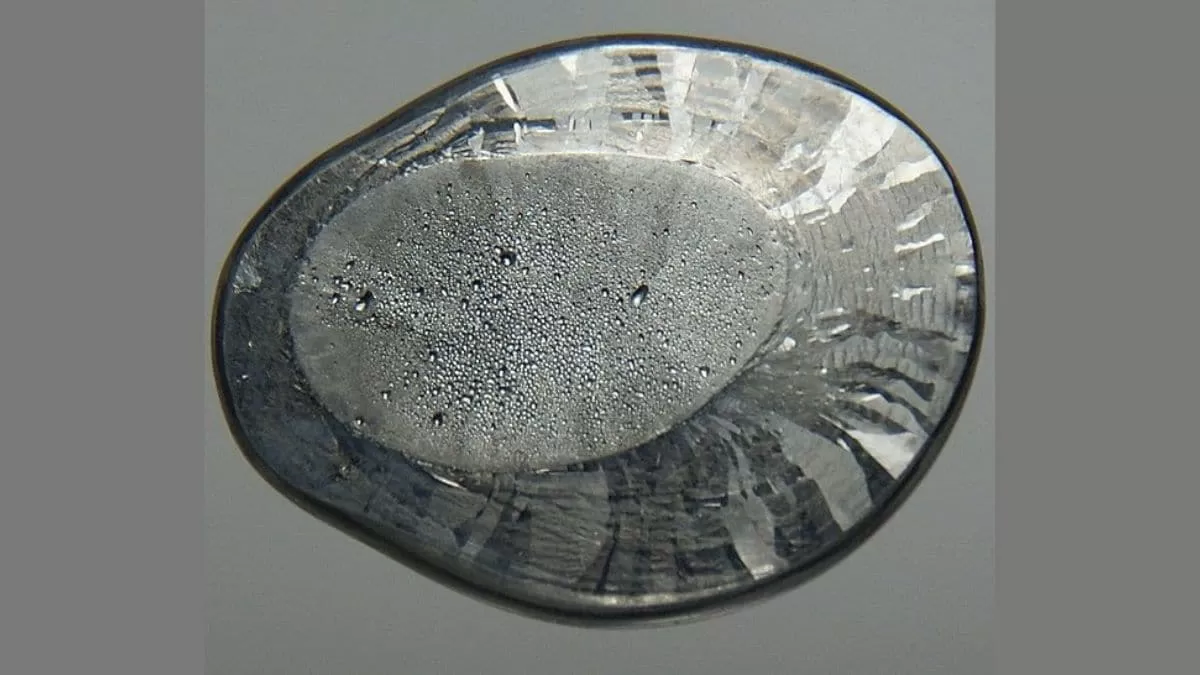
In a groundbreaking experiment at CERN’s Large Hadron Collider, a team of scientists has achieved the seemingly impossible – they briefly turned lead into gold. Through a series of near-miss atomic collisions, the ALICE collaboration was able to remove three protons from lead atoms, resulting in the creation of 89,000 gold atoms per second. While this may not have any economic significance, it is a remarkable feat that showcases the precision and advancement of particle physics.
The concept of turning lead into gold has fascinated scientists and alchemists for centuries. It was believed that this transformation could lead to unlimited wealth and power. However, it was only through the use of modern technology and the collaboration of brilliant minds that this feat was finally achieved.
The ALICE (A Large Ion Collider Experiment) collaboration at CERN consists of a team of over 1,500 scientists and engineers from 37 countries. Their primary goal is to study the properties of matter under extreme conditions by colliding heavy ions at high energies. This latest experiment is just one of their many groundbreaking achievements.
The process of turning lead into gold may sound like something out of a fantasy novel, but it is actually based on scientific principles. Lead and gold are both elements on the periodic table, with lead having 82 protons and gold having 79. By removing three protons from a lead atom, scientists were able to create a gold atom. This was achieved by accelerating lead ions to nearly the speed of light and then colliding them with a target made of nickel. The resulting collisions caused some of the lead atoms to lose three protons, transforming them into gold atoms.
This process, known as nuclear transmutation, has been theorized for many years but has never been successfully demonstrated on such a small scale. It is a testament to the precision and accuracy of the equipment used at CERN’s Large Hadron Collider. The fact that scientists were able to control the collisions to the point where they could remove exactly three protons from a lead atom is a remarkable achievement.
While the amount of gold produced in this experiment may seem insignificant, it is important to note that each gold atom only existed for a fraction of a second. This is due to the unstable nature of the atoms created through nuclear transmutation. However, it is a significant step forward in our understanding of particle physics and the potential applications of nuclear transmutation.
The ALICE collaboration’s achievement has not only showcased the incredible precision of particle physics but also has potential implications for the future. Nuclear transmutation could be used to create new elements that do not exist naturally on Earth, which could have a wide range of uses in various industries. It could also lead to advancements in nuclear medicine, as certain elements produced through transmutation could be used for medical treatments.
This landmark experiment at CERN’s Large Hadron Collider is a testament to the power of collaboration and human curiosity. It has once again shown that when brilliant minds come together and push the boundaries of science, anything is possible. The ALICE collaboration’s achievement has opened up new possibilities and has paved the way for future advancements in the field of particle physics.
In conclusion, the brief transformation of lead into gold by the ALICE collaboration at CERN’s Large Hadron Collider is a remarkable achievement that showcases the precision and advancements of particle physics. While it may not have any economic significance, it is a significant step forward in our understanding of nuclear transmutation and its potential applications. This breakthrough is a testament to the power of human curiosity and the endless possibilities of science.

