
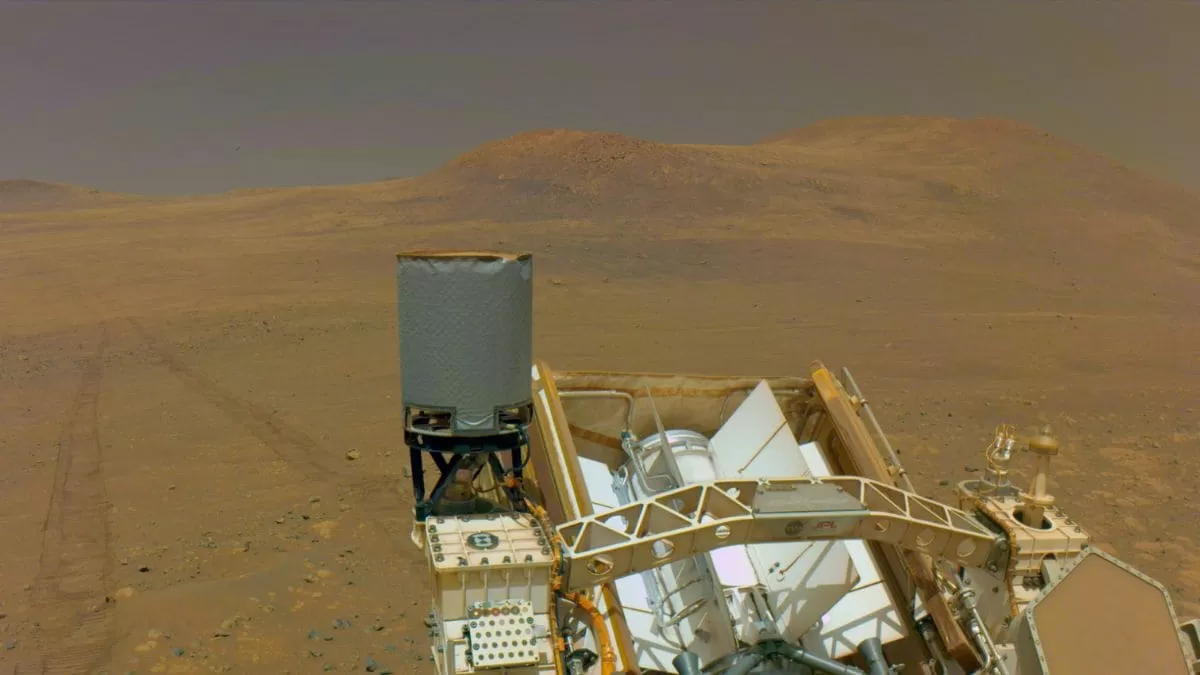
NASA’s Perseverance rover has reached Krokodillen, a 73-acre plateau on Mars, marking another milestone in the ongoing mission to explore the Red Planet. The rover, which landed on Mars in February this year, has been making steady progress towards Jezero Crater’s rim, where it is believed to find some of the oldest rocks on Mars. The latest data from the rover’s instruments has revealed some exciting findings, hinting at a past presence of water on the planet.
Krokodillen, named after the crocodile-shaped plateau, is a significant location for the Perseverance rover. It is situated near the rim of the Jezero Crater, which is the site of a former lake that existed billions of years ago. Scientists believe that the rocks in this region are some of the oldest on Mars and could provide valuable insights into the planet’s ancient past.
Preliminary data from the rover’s instruments has shown evidence of clays, carbonates, and olivine minerals in the area. These minerals are known to form in the presence of water. This discovery is a significant step in the search for signs of past life on the Red Planet. It strengthens the belief that Mars was once a habitable planet with a potentially active water cycle.
The Perseverance rover is currently examining a site named Copper Cove, located on the northwestern edge of Krokodillen. The rover’s mission is to collect rock samples from this area using its state-of-the-art sampling system. The samples will then be stored and eventually returned to Earth for in-depth analysis.
What makes the sampling process unique this time is the use of a new strategy. The rover’s team has developed a method that allows for unsealed rock core samples to be collected. This is a significant breakthrough as it gives access to a wider range of samples, including those with a weathered surface. The strategy also minimizes the risk of losing samples due to contamination during the sealing process.
“The ability to collect unsealed rock core samples is a game-changer for our mission,” said Jennifer Trosper, Perseverance project manager at NASA’s Jet Propulsion Laboratory. “This will allow us to get a more holistic understanding of the rock composition and determine if it is indeed a place where life could have existed.”
The rover’s sophisticated instruments, like the PIXL and SHERLOC, will be used to study the mineral makeup of the rocks in Copper Cove. These instruments can identify chemical elements and even detect organic molecules, which are essential building blocks of life.
The Copper Cove site is just the beginning. The Perseverance rover is expected to explore multiple locations within Krokodillen, including the Jezero Crater’s rim, in the coming months. The data gathered from these sites will help scientists paint a detailed picture of Mars’ past environment and its potential for supporting life.
The successful landing of the Perseverance rover on Mars and its ongoing mission have captivated the world’s attention. This mission promises to uncover new mysteries of the Red Planet and bring us closer to answering the age-old question – is there life on Mars?
The latest findings from the rover have sparked excitement and optimism among the scientific community. “The evidence of ancient water activity in the region is incredibly intriguing. It opens up a whole new realm of possibilities for our understanding of Mars,” says Lisa Pratt, NASA’s planetary protection officer.
The perseverance and dedication of the team behind the Perseverance rover have paid off, and it is just the beginning. With new discoveries on the horizon, the mission is well on its way to making history and advancing our knowledge of the Red Planet.
In addition to its scientific objectives, the Perseverance rover also aims to pave the way for future human exploration of Mars. The data and samples collected from this mission will be crucial in planning and preparing for future missions to the planet.
The Perseverance rover’s mission on Mars is a testament to human curiosity and the endless pursuit of knowledge. With each step taken by the rover, we are one step closer to unlocking the mysteries of our neighboring planet. As we continue to explore and push the boundaries of space exploration, let us celebrate this extraordinary achievement and look forward to many more exciting discoveries to come.

