
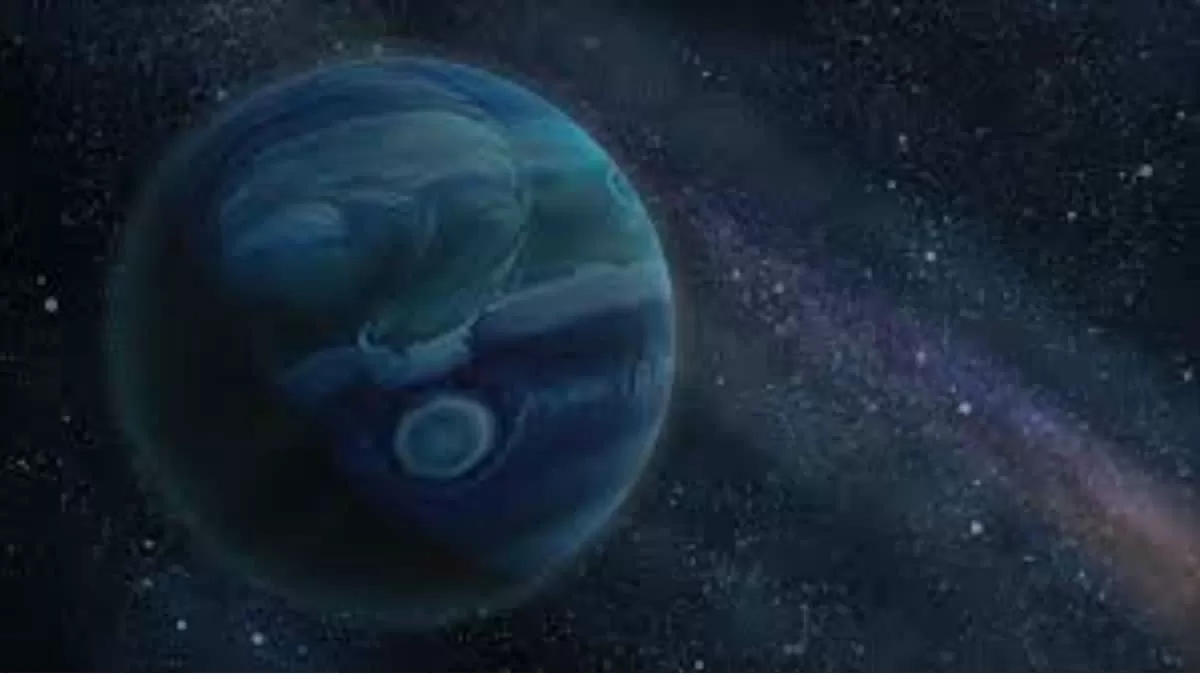
For centuries, the vast expanse of our solar system has captivated astronomers and scientists alike. Despite countless advancements in technology and a better understanding of the cosmos, there are still mysteries waiting to be solved. One such mystery is the existence of a hidden planet known as Planet Nine.
Proposed in 2016 by a team of researchers from the California Institute of Technology (Caltech), the theory of Planet Nine suggests that there is an elusive ninth planet lurking somewhere beyond Neptune. Its discovery would not only expand our understanding of the solar system but also change the way we perceive the universe.
The first hints of Planet Nine’s existence came from the mysterious behavior of distant objects in the Kuiper Belt, a region of icy objects at the edge of our solar system. These objects, also known as trans-Neptunian objects, have strangely elongated orbits that cannot be explained by the gravitational pull of the known planets. This led astronomers to theorize that there must be an unseen massive object exerting its influence on these objects.
Initially, the idea of a hidden planet seemed far-fetched to some. But as more evidence surfaced, the theory gained momentum. In 2016, astronomers Konstantin Batygin and Mike Brown published their findings, which supported the existence of Planet Nine. According to their calculations, this planet would be about ten times the mass of Earth and take around 20,000 years to complete one orbit around the sun.
Despite the enthusiastic response from the scientific community, the hunt for Planet Nine has not been without its challenges. One such challenge is the extremely faint signal that the planet emits due to its distance from the sun. This makes it difficult for even the most powerful telescopes to spot it. Moreover, the exact location of Planet Nine remains a mystery, making it a needle in a haystack for astronomers to find.
However, the team at Caltech remains undeterred. They are confident that they will be able to spot Planet Nine with the help of the Large Synoptic Survey Telescope, which is expected to be operational by 2023. This telescope has an incredibly wide field of view and will scan the entire sky multiple times each week, making it the perfect tool to search for this elusive planet.
While the theory of Planet Nine remains the most popular and widely accepted explanation for the strange orbits of trans-Neptunian objects, there are some who remain skeptical. Some scientists have proposed alternative theories, including the idea that these unusual orbits could be a result of debris rings or even a black hole. However, these theories have not gained much traction as they fail to explain all the observations.
Recently, a new study has proposed yet another alternative theory to explain the puzzling orbits. This study suggests that these objects might have been formed near Neptune and then pushed outward by the gravitational pull of Jupiter. While this theory cannot be completely ruled out, it has been met with some skepticism from the scientific community.
Despite doubts from some quarters, the theory of Planet Nine continues to inspire and intrigue astronomers and space enthusiasts. Its potential discovery would be groundbreaking, not only because it would expand our knowledge of the solar system, but also because it would provide new insights into the formation and evolution of our cosmic neighborhood.
The discovery of Planet Nine would also have implications beyond our solar system. It could help us understand the formation of other planetary systems and provide new clues about the elusive Planet X, a hypothetical planet in the outer reaches of our own solar system.
Moreover, the hunt for Planet Nine has led to the discovery of other fascinating objects and phenomena in our solar system. For instance, in 2019, researchers announced the discovery of a dwarf planet named “The Goblin,” which has an orbit that could be influenced by the gravitational pull of Planet Nine. Similarly, the search for Planet Nine has also led to the discovery of other small, icy objects at the edge of our solar system.
In conclusion, the existence of Planet Nine continues to be a subject of intense speculation and fascination among astronomers. While its discovery is yet to be confirmed, the theory has opened up new avenues of research and expanded our understanding of the solar system. Whether Planet Nine turns out to be a real entity or not, the hunt for it has taught us that there is still so much we have yet to unravel about the vast and mysterious universe we live in.

