
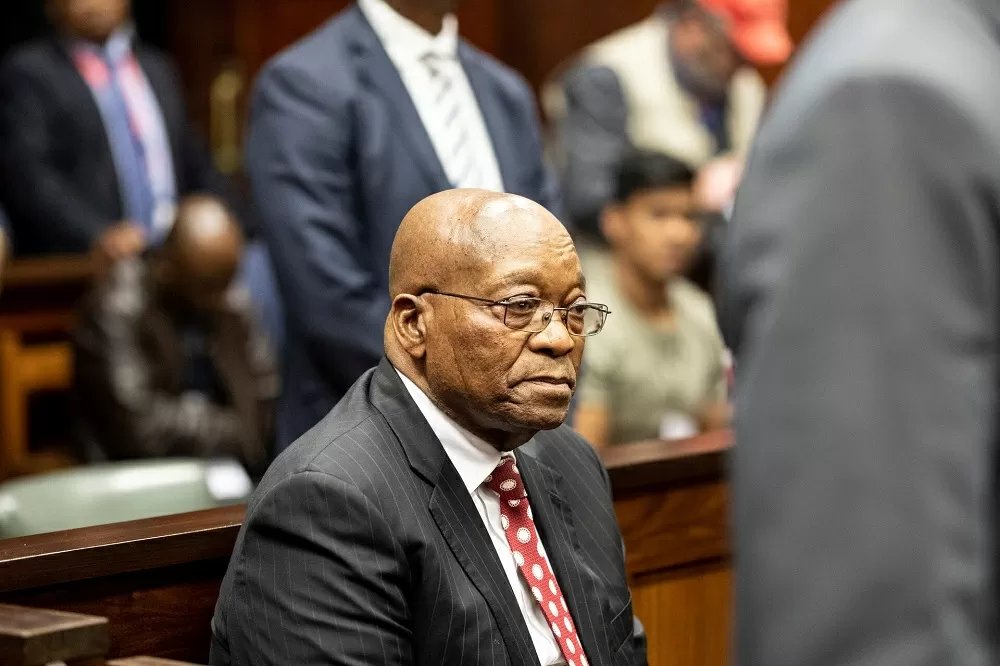
The South African High Court has recently ruled that former President Jacob Zuma must repay a staggering amount of R28.96 million in legal fees. This decision, made on Tuesday, has been met with widespread praise and has been hailed as a victory for justice and accountability.
The legal fees in question were incurred during Zuma’s bid to fight corruption charges, and were paid by the state. However, with the former president’s resignation in February 2018, the court has found that he is no longer entitled to this financial support. The ruling has been met with widespread approval, as it sends a strong message that no one is above the law and that corrupt individuals will be held accountable for their actions.
The High Court’s decision comes as a result of an application brought by the Democratic Alliance (DA) in 2018, challenging the legality of the state funding Zuma’s legal battles. The DA argued that the state should not be burdened with the cost of defending a private individual in corruption cases. In response, Zuma’s legal team argued that he was entitled to state funding as he was acting in his capacity as the president at the time. However, the court has dismissed this argument, stating that Zuma was not acting in the best interest of the country, but rather in his own personal interests.
The ruling has been praised by many, including the DA and other political parties, as well as civil society organizations. The DA’s federal council chairperson, James Selfe, has stated that this is a significant victory for the rule of law and has sent a strong message that corruption will not be tolerated in South Africa. He also expressed his hope that this ruling will set a precedent for future cases involving state funding for private individuals.
This decision also marks a significant step towards ensuring that taxpayers’ money is used for its intended purpose and not for the personal gain of corrupt individuals. It is a clear indication that the South African justice system is committed to holding those in power accountable for their actions.
The ruling has also been praised for its impact on the fight against corruption in South Africa. Corruption has been a major issue in the country, with the former president himself facing numerous allegations of corruption and state capture. This ruling serves as a reminder that those in positions of power will be held accountable for their actions and that the law will not show any leniency towards corrupt individuals.
Furthermore, the court’s decision has also been hailed as a victory for the South African public. With the country facing numerous challenges, including high levels of unemployment and poverty, the repayment of these legal fees will free up much-needed funds that can be used for the betterment of the country and its citizens.
The ruling also serves as a reminder that the South African justice system is fair and impartial, and will not be swayed by political influence. It is a testament to the strength and independence of the country’s judiciary, which plays a crucial role in upholding the rule of law and ensuring justice for all.
In conclusion, the High Court’s decision to order former President Jacob Zuma to repay R28.96 million in legal fees is a significant victory for justice, accountability, and the fight against corruption in South Africa. It sends a strong message that no one is above the law and that corrupt individuals will be held accountable for their actions. This ruling is a positive step towards a more transparent and just society, and it is a reminder that the South African justice system is committed to upholding the rule of law and serving the best interests of its citizens.

