
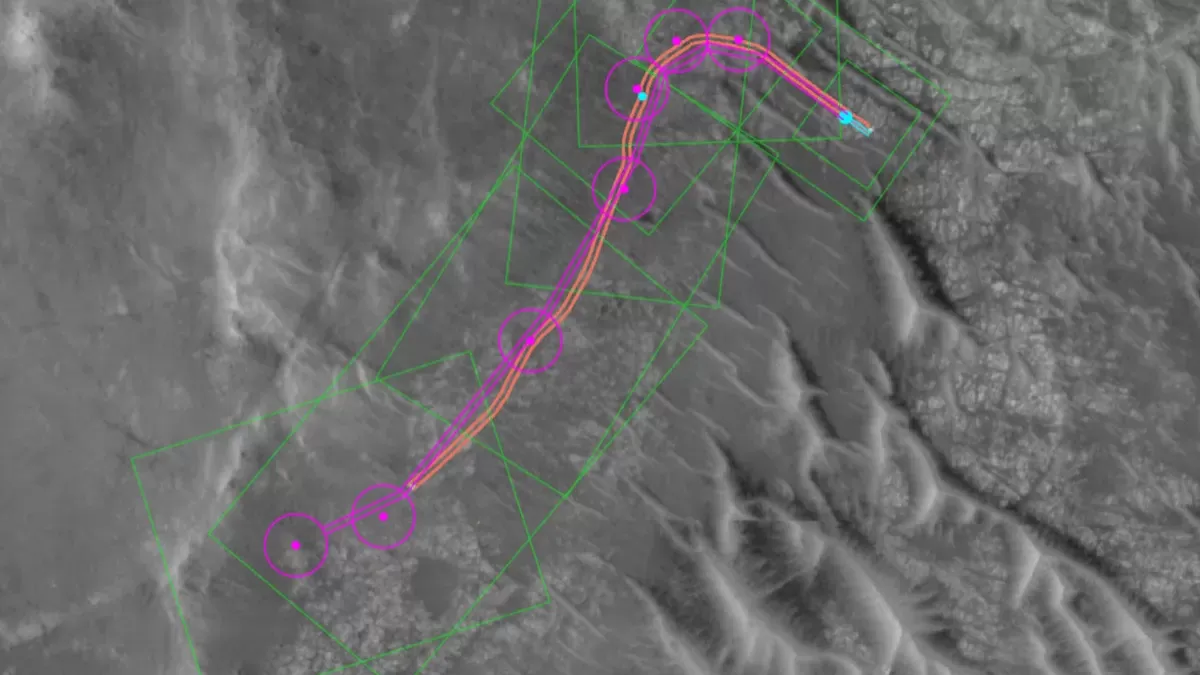
NASA’s Perseverance rover has once again made history by achieving a major milestone in its mission on Mars. In December 2025, the rover successfully navigated the treacherous terrain of Jezero Crater using artificial intelligence (AI) alone. This groundbreaking achievement has proven that autonomous navigation can significantly speed up exploration and increase the scientific returns of future planetary missions.
The Perseverance rover, which landed on Mars in February 2021, has been equipped with state-of-the-art technology and instruments to search for signs of ancient microbial life on the red planet. One of its key capabilities is its autonomous navigation system, which allows the rover to make its own decisions and choose its own path without human intervention.
Traditionally, rovers on Mars have been controlled by human operators on Earth, who carefully plan and map out each movement. This process can be time-consuming and limits the rover’s ability to cover a large area. However, with the use of AI, the Perseverance rover has been able to navigate the Martian terrain at a much faster pace, covering a distance of 6.5 kilometers in just 10 days.
The success of the rover’s autonomous navigation was demonstrated in December 2025, when it traversed the challenging terrain of Jezero Crater. This 49-kilometer-wide crater is believed to have once been a lake, making it a prime location to search for evidence of past microbial life. However, the crater is also filled with hazards such as steep cliffs, sand dunes, and boulder fields, making it a difficult area to navigate.
Using AI-generated routes, the Perseverance rover was able to safely maneuver through the crater, avoiding potential obstacles and hazards. This not only saved time but also reduced the risk of the rover getting stuck or damaged. The rover’s ability to autonomously navigate through such a complex terrain has opened up new possibilities for future missions to Mars.
One of the key advantages of using AI for navigation is its ability to adapt and learn from its surroundings. The Perseverance rover’s AI system is constantly analyzing data from its cameras and sensors, allowing it to make real-time decisions and adjust its path accordingly. This means that the rover can explore areas that were previously deemed too risky or inaccessible, providing scientists with valuable data and insights.
The success of the Perseverance rover’s autonomous navigation has significant implications for future planetary missions. With the use of AI, rovers and other spacecraft can cover larger areas and explore more diverse terrains, increasing the chances of making groundbreaking discoveries. This also means that missions can be completed in a shorter amount of time, reducing costs and allowing for more frequent explorations.
Moreover, autonomous navigation can also play a crucial role in human missions to Mars. As we plan for future crewed missions to the red planet, the ability to navigate autonomously will be essential for the safety and efficiency of the mission. AI-powered rovers can be sent ahead to map out the terrain and identify potential hazards, making it easier for astronauts to navigate and explore the planet.
The success of the Perseverance rover’s autonomous navigation is a testament to the incredible advancements in AI technology. NASA’s Jet Propulsion Laboratory, which developed the rover’s AI system, has been at the forefront of developing cutting-edge AI for space exploration. This achievement is a result of years of research and development, and it has opened up new possibilities for future missions to Mars and beyond.
In addition to its autonomous navigation capabilities, the Perseverance rover has also been conducting a wide range of scientific experiments and collecting samples of Martian rocks and soil. These samples will be returned to Earth by a future mission, where they will be analyzed for signs of ancient microbial life. The rover has also been testing a helicopter, called Ingenuity, which successfully completed its first flight on Mars in April 2021.
The Perseverance rover’s mission on Mars is a testament to human ingenuity and our unrelenting curiosity to explore the unknown. With each milestone achieved, we are one step closer to unraveling the mysteries of our neighboring planet and potentially finding answers to some of the biggest questions about the origins of life in our solar system.
In conclusion, the successful navigation of the Perseverance rover using AI alone is a major achievement for NASA and the field of space exploration. It has proven that autonomous navigation can significantly speed up exploration and increase the scientific returns of future

