
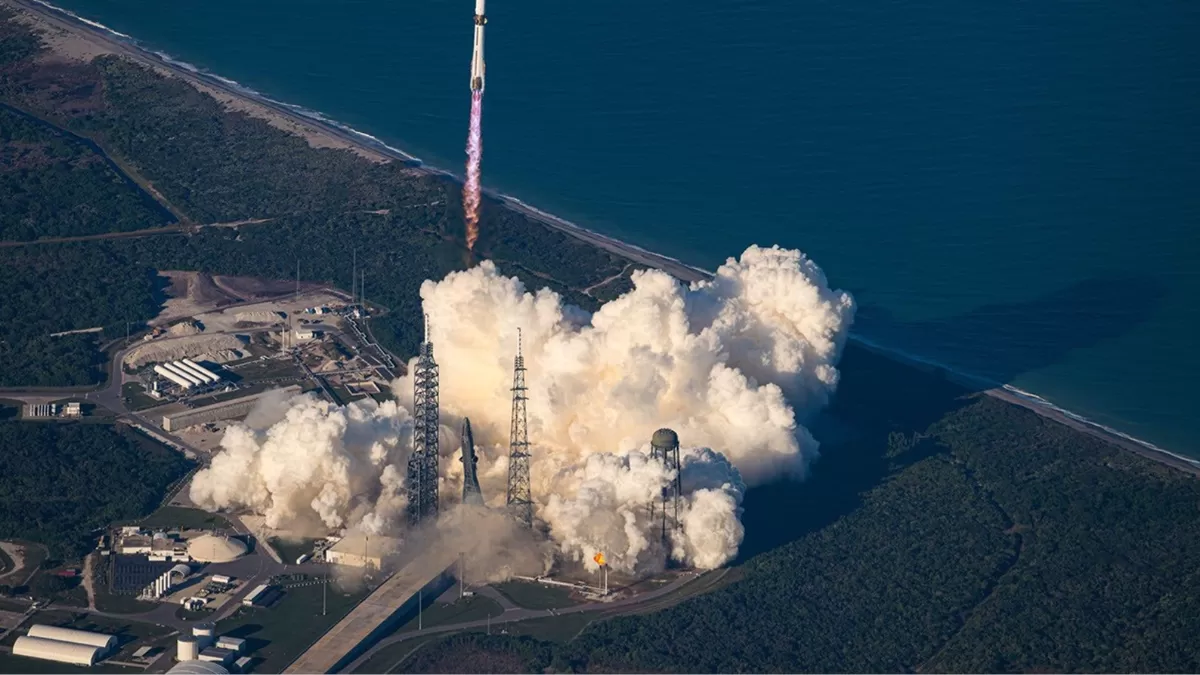
NASA’s latest mission to Mars, called the ESCAPADE (Escape and Plasma Acceleration and Dynamics Explorers) Mission, is set to launch in 2025. This groundbreaking mission will send two identical orbiters to the Red Planet to study how solar wind and space weather have stripped away its atmosphere over millions of years.
The two spacecraft, which are scheduled to arrive in Mars in 2027, will work in tandem to collect critical data on the planet’s atmosphere and its response to solar wind. This will provide scientists with valuable insights into how Mars lost its once-thick atmosphere and how solar storms continue to shape its environment today.
NASA’s fascination with Mars dates back to the 1960s, when the agency first sent robotic spacecraft to the planet. Since then, numerous missions have been launched to unravel the mysteries of this neighboring planet. However, the ESA and NASA’s 2016 Exomars mission was the first to send a spacecraft dedicated to studying the atmosphere of Mars.
Building on the success of this mission, the ESA and NASA have joined forces once again to launch the ESCAPADE mission. This collaboration will allow the two space agencies to combine their resources, expertise, and technological capabilities to conduct a comprehensive study of Mars’s atmosphere.
The main objective of the ESCAPADE mission is to understand the role of solar wind in the atmospheric loss of Mars. Solar wind, a stream of charged particles emanating from the sun, can strip away the protective magnetic field of a planet, ultimately leading to the erosion of its atmosphere. On Earth, this magnetic field is created by the planet’s molten core, but Mars does not have a molten core, making it more vulnerable to the effects of solar wind.
To study this phenomenon, the twin spacecraft will orbit Mars at different altitudes, collecting data on the planet’s atmosphere and its interaction with solar wind. This will provide a comprehensive picture of how solar wind conditions and Mars’s atmospheric response are interconnected.
The two spacecraft will carry a suite of instruments, including an energetic particle analyzer, a magnetometer, and a plasma analyzer. These instruments will measure the properties of solar wind, such as its speed, density, and temperature, as well as the characteristics of Mars’s atmosphere, including its composition, density, and temperature.
One of the key elements of this mission is the simultaneous measurements taken by the twin spacecraft. This will allow scientists to compare and correlate data from both spacecraft, providing a more complete understanding of the dynamics of Mars’s atmosphere.
In addition to studying the effects of solar wind on Mars’s atmosphere, the ESCAPADE mission will also help scientists to better understand the present-day climate of the Red Planet. Solar storms and other space weather events can have a significant impact on Mars’s environment, and the data collected by the twin spacecraft will provide valuable insights into these phenomena.
The ESCAPADE mission will also pave the way for future human exploration of Mars. By understanding the dynamics of the planet’s atmosphere and how it responds to solar wind and space weather, scientists will be better equipped to protect astronauts from these harmful effects during future missions.
Furthermore, the data collected by the twin spacecraft will be crucial for future terraforming efforts on Mars. Terraforming is the process of transforming a planet to make it habitable for humans, and Mars is a prime candidate for this process. However, to successfully terraform Mars, scientists need to understand how to create an atmosphere that is stable and can withstand the harsh conditions of the Red Planet.
In conclusion, NASA’s ESCAPADE mission is a significant step towards unraveling the mysteries of Mars’s atmosphere. By studying the effects of solar wind and space weather on the planet, this mission will provide valuable insights into how the Red Planet lost its once-thick atmosphere and how it continues to evolve today. With the collaboration of ESA and NASA and the advanced technology of the twin spacecraft, we can look forward to groundbreaking discoveries and a better understanding of our neighboring planet.

