
Astronomers have always been fascinated by the mysteries of our universe, constantly seeking to unravel its secrets through the use of powerful telescopes. And recently, they have made a groundbreaking discovery that has shed new light on one of the most intriguing celestial objects – the Cat’s Eye Nebula.
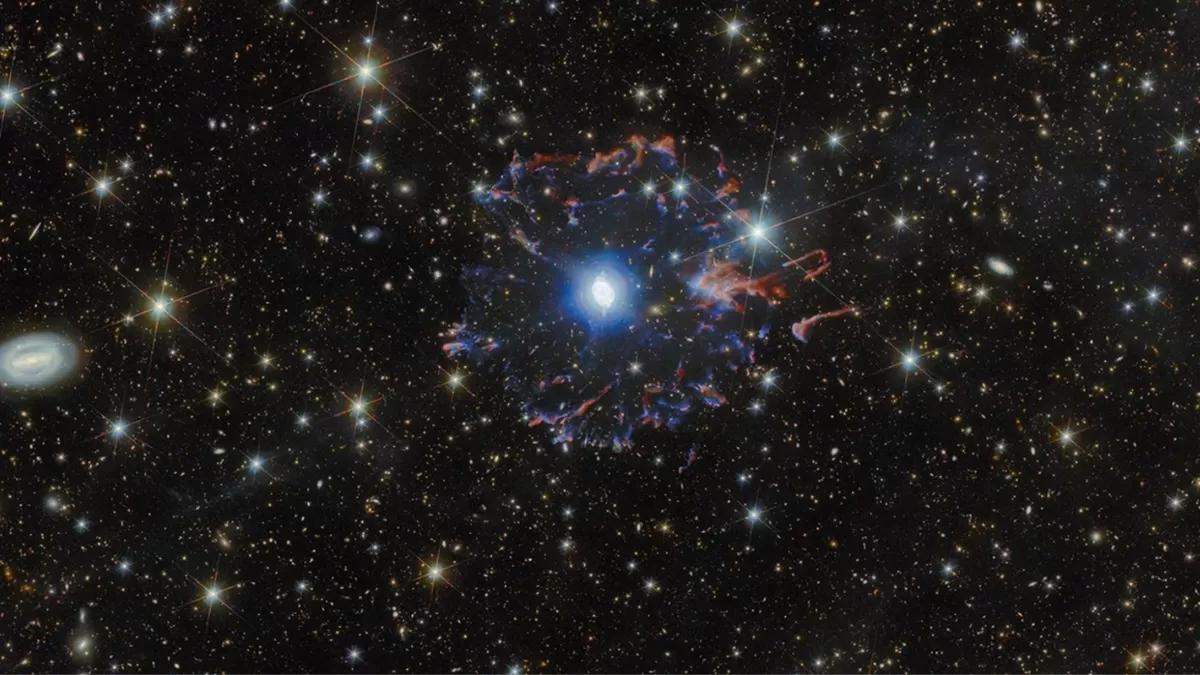
Combining observations from the Hubble and Euclid space telescopes, astronomers have produced a detailed image of the Cat’s Eye Nebula. The composite view is a marvel to behold, revealing intricate shells, jets, and a faint outer ring formed from earlier eruptions of the dying star.
The Cat’s Eye Nebula, also known as NGC 6543, is a planetary nebula located in the constellation Draco, approximately 3,000 light-years away from Earth. It is the result of a dying star, in its final stages of life, shedding its outer layers into space, creating a beautiful, glowing cloud of gas and dust.
While the Cat’s Eye Nebula has been studied extensively for decades, this new composite image provides a never-before-seen view of its inner workings. By combining the capabilities of the Hubble and Euclid telescopes, astronomers were able to capture both visible and infrared light, providing a more comprehensive look at the nebula.
The image reveals intricate, concentric shells of gas and dust, each representing a different stage in the star’s evolution. The innermost shell, which appears to have a jagged edge, is thought to have formed when the star shed its outer layers in a series of eruptions. This shell is surrounded by a smooth, outer ring, likely formed by a more recent eruption.
But the Cat’s Eye Nebula has more secrets to reveal. The composite image also reveals several jets of gas streaming out of the central star, traveling at incredible speeds of over 1 million kilometers per hour. These jets are formed when the central star’s magnetic fields interact with the surrounding gas, creating a powerful, high-speed outflow.
Additionally, the image also captures a faint outer ring, believed to be formed from an eruption that occurred thousands of years ago. This outer ring is puzzling to astronomers as it is not typically seen in other planetary nebulae, making the Cat’s Eye Nebula truly one-of-a-kind.
The combination of the Hubble and Euclid telescopes has also provided valuable insights into the chemical composition of the Cat’s Eye Nebula. By studying the infrared light emitted by the nebula, astronomers were able to identify a variety of elements and molecules, including hydrogen, helium, nitrogen, and carbon monoxide. These findings help us better understand the processes that occur during a star’s death throes.
Apart from its scientific value, the composite image of the Cat’s Eye Nebula is also a breathtaking work of art. The intricate layers and structures captured in the image are a testament to the beauty and complexity of our universe.
This groundbreaking discovery is a testament to the power of collaboration and the incredible advancements in technology. By combining the capabilities of two of the most powerful space telescopes, astronomers have been able to unlock the secrets of the Cat’s Eye Nebula, providing us with a better understanding of the processes that occur during a star’s death.
The composite image of the Cat’s Eye Nebula is a reminder of the vastness and complexity of our universe, and the endless possibilities that await us in the great expanse of space. It is a testament to our insatiable curiosity and our unending quest to understand the mysteries of the cosmos.
As we continue to explore and push the boundaries of our understanding of the universe, who knows what other wonders we may uncover? The Cat’s Eye Nebula is a reminder that the possibilities are endless, and the wonders of our universe are waiting to be discovered.

