
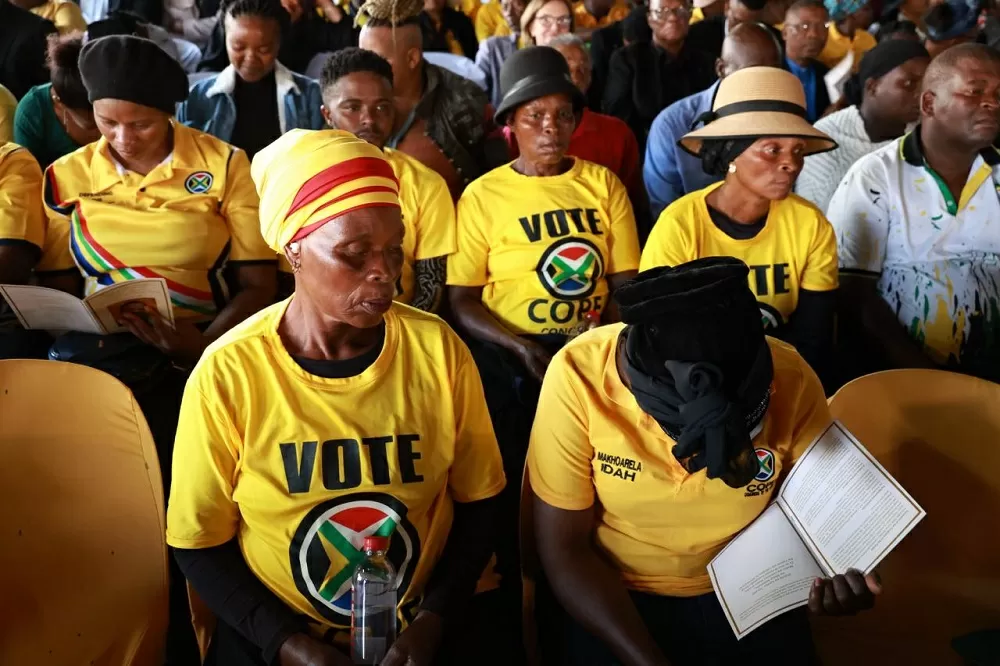
In 2008, a significant event rocked the political landscape of South Africa. Mosiuoa Lekota, a long-time member and leader of the African National Congress (ANC), made the bold decision to break away and form a new political party, the Congress of the People (COPE). This decision not only marked a pivotal moment in Lekota’s political career, but also in the history of South Africa. Let us take a closer look at the circumstances that led to this momentous decision and the impact it had on the country.
Lekota, a veteran anti-apartheid activist, had been a prominent member of the ANC for over 30 years. He had served as a Member of Parliament, a Minister, and a Provincial Premier, among other roles. However, in 2008, he found himself at odds with the ANC leadership and its direction. Lekota, along with other senior ANC members such as Mbhazima Shilowa and Mluleki George, believed that the party had strayed from its founding principles and was no longer representing the interests of the people. They felt that the ANC had become corrupt, and its leadership had lost touch with the needs of the citizens.
These concerns were further amplified by the controversial ousting of Thabo Mbeki as the President of South Africa in 2008. Lekota and others believed that this move was orchestrated by the ANC leadership and went against the principles of democracy and the rule of law. This event was the final straw for Lekota, who decided to break away and form a new political party that would uphold the values of democracy, accountability, and service to the people.
Thus, in November 2008, COPE was officially launched, with Lekota as its President and Shilowa as its Deputy President. The party’s name was inspired by the historical event of the signing of the Freedom Charter in 1955, where thousands of South Africans came together under the banner of the Congress of the People to declare their vision for a free and democratic South Africa.
The formation of COPE sent shockwaves throughout the country and sparked heated debates and discussions. Many were curious to see how this new party would fare in the upcoming 2009 national elections. Would it be able to challenge the dominance of the ANC, which had been in power since the end of apartheid? Would it be able to make a significant impact on the political landscape of South Africa?
In the months leading up to the elections, COPE gained considerable traction, with many disillusioned ANC members and supporters joining its ranks. The party’s message of putting the people’s interests first and fighting against corruption and abuse of power resonated with many. COPE also attracted a diverse group of individuals, including former members of the ANC, the Democratic Alliance, and other political parties, as well as young activists and intellectuals.
However, COPE faced many challenges during its short existence. The party was plagued by internal conflicts and power struggles, resulting in the resignation of Shilowa and other key leaders. This, coupled with limited resources and time, made it difficult for COPE to establish a strong presence and gain the trust of the electorate. In the end, the party only managed to secure 7.42% of the national vote, winning 30 seats in parliament.
Despite this, COPE’s impact on South African politics cannot be underestimated. The party’s formation forced the ANC to take a critical look at itself and its practices. It also provided an alternative for those who were dissatisfied with the ruling party, showing that a change in leadership was possible. COPE also played a significant role in exposing and bringing to light instances of corruption and maladministration within the government.
Moreover, COPE’s contribution to the political discourse of the country cannot be overlooked. The party’s emphasis on the values of democracy, accountability, and service to the people served as a reminder to all political parties of their responsibilities to the citizens of South Africa.
Today, COPE may no longer be a prominent force in South African politics, but its legacy lives on. The party’s formation and existence have shown that democracy and the right to dissent are alive and well in the country. It has also paved the way for the emergence of other political parties that continue to challenge the status quo and provide diverse options for the people to choose from.
In conclusion, Mosiuoa Lekota’s decision to break away from the ANC

