
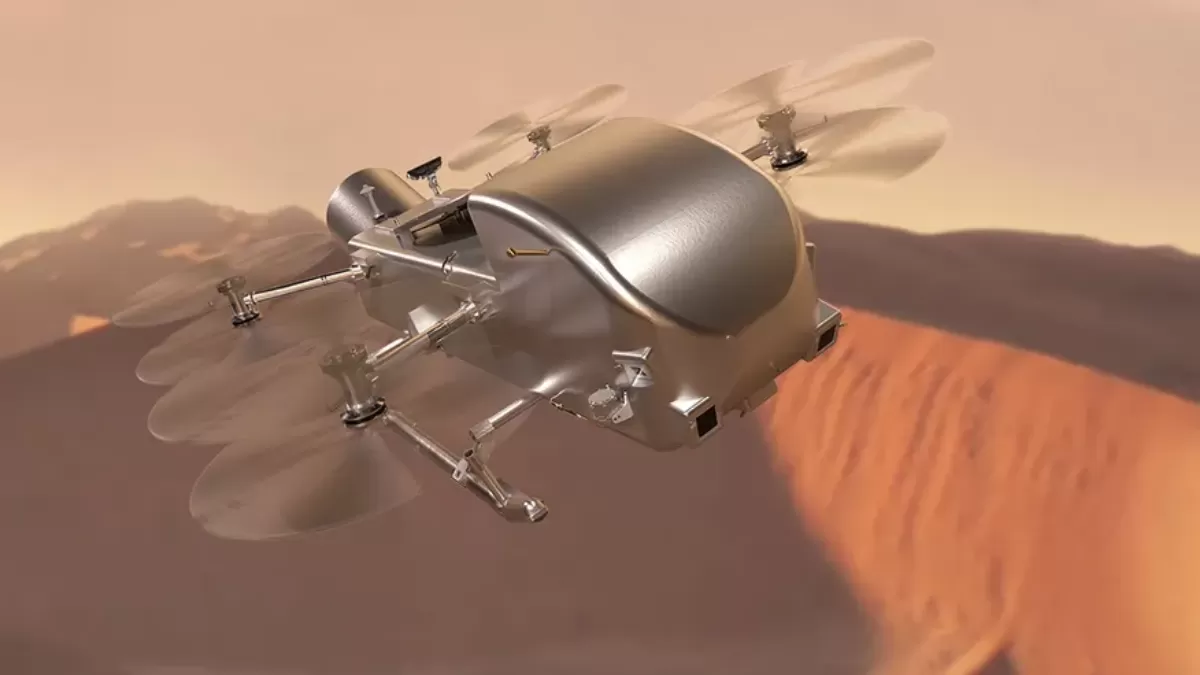
NASA has always been at the forefront of space exploration, constantly pushing the boundaries of what is possible and expanding our knowledge of the universe. And now, they have embarked on a groundbreaking new mission that is set to revolutionize our understanding of Saturn’s largest moon, Titan.
The Dragonfly mission, announced by NASA in 2019, is a bold and ambitious project that will utilize a nuclear-powered rotorcraft lander to investigate the mysterious and intriguing moon. This car-sized drone is scheduled to launch in 2028 and will embark on a six-year journey to reach Titan in 2034.
The spacecraft will be equipped with a Multi-Mission Radioisotope Thermoelectric Generator (MMRTG), a cutting-edge technology that will provide the necessary power for the mission. This will allow the spacecraft to conduct a comprehensive surface survey, gathering valuable data and images that will help us understand Titan like never before.
But why Titan? What makes this moon so special and worthy of such a mission? Well, for starters, Titan is the only moon in our solar system with a dense atmosphere, even thicker than Earth’s. It is also the second-largest moon in our solar system, after Jupiter’s Ganymede. But perhaps the most intriguing aspect of Titan is that it is the only other body in our solar system, besides Earth, to have stable bodies of liquid on its surface.
However, these are not your typical bodies of water. Instead of water, Titan’s lakes and seas are made up of liquid methane and ethane, due to the moon’s extremely cold temperatures. This makes Titan a unique and fascinating destination for exploration, as it could potentially hold clues about the origins of life on Earth.
The Dragonfly mission aims to take advantage of Titan’s unique environment and conduct detailed exploration activities across its surface. The spacecraft will fly to multiple locations on the moon, using its rotorcraft capabilities to hop from one site to another. This will allow for a comprehensive survey of the moon’s diverse terrain, including its lakes, dunes, and mountains.
One of the key objectives of the mission is to search for signs of past or present life on Titan. The spacecraft will carry a suite of instruments, including cameras, spectrometers, and drills, to collect samples and analyze the chemical composition of the moon’s surface. This will provide valuable insights into the moon’s geology and potential habitability.
But the Dragonfly mission is not just about scientific discovery. It also has practical applications that could benefit future space exploration missions. The rotorcraft technology used in this mission could pave the way for future missions to other moons and planets, where traditional rovers may not be able to navigate the terrain.
The use of a nuclear-powered generator also opens up new possibilities for longer and more ambitious missions, as it provides a reliable and long-lasting source of power. This could be crucial for future human missions to other planets and moons.
The Dragonfly mission is a testament to NASA’s commitment to pushing the boundaries of space exploration and expanding our understanding of the universe. It is a bold and ambitious project that has the potential to revolutionize our understanding of Titan and provide valuable insights into the origins of life in our solar system.
As we eagerly await the launch of the Dragonfly spacecraft in 2028, we can only imagine the groundbreaking discoveries and advancements that this mission will bring. It is a reminder that there is still so much to explore and discover in our vast universe, and NASA is leading the way in this exciting journey of exploration.

