
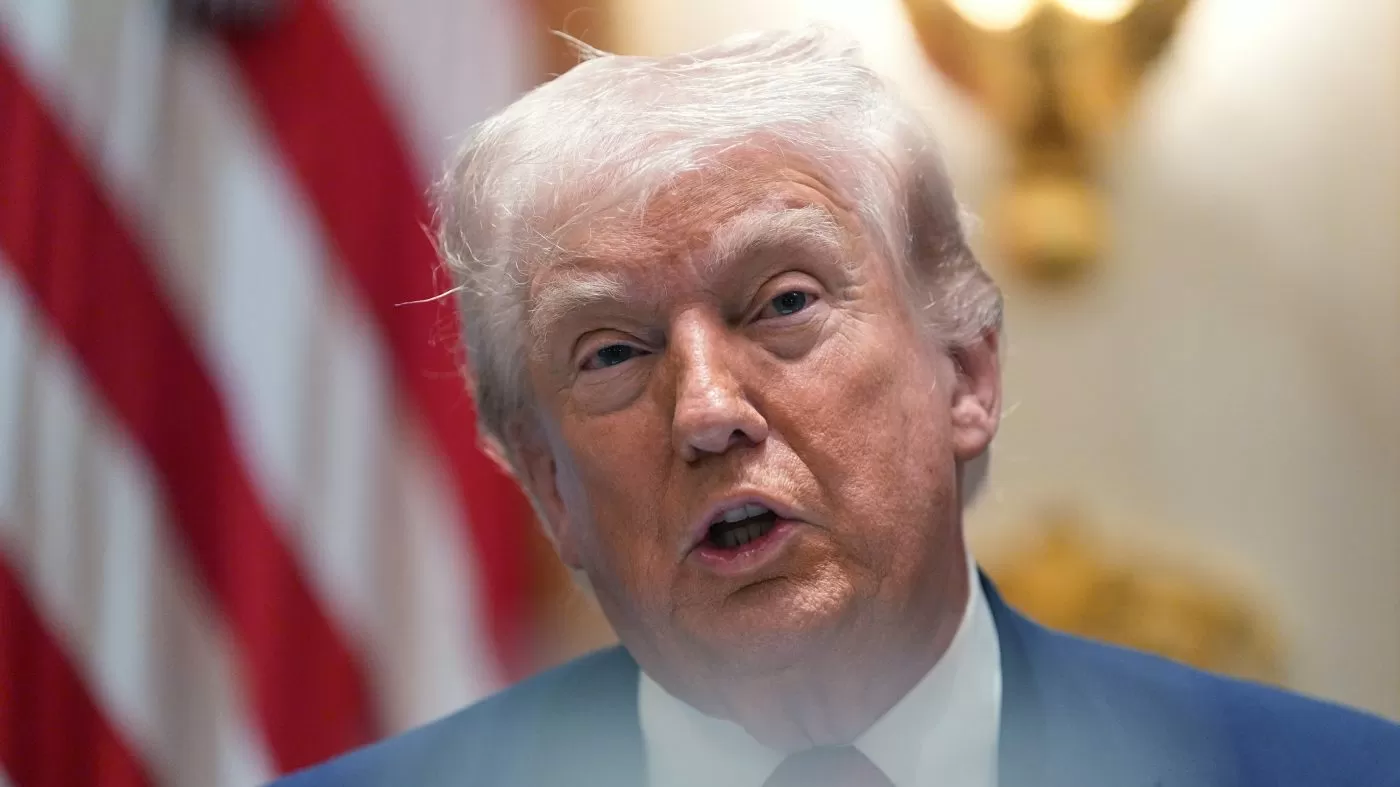
President Trump has once again made headlines with his bold statements, this time regarding the United States’ membership in the North Atlantic Treaty Organization (NATO). In a recent interview, the President declared that U.S. membership in NATO is “beyond reconsideration,” firmly standing by his belief that the alliance is a “paper tiger.”
The North Atlantic Treaty Organization, or NATO, was formed in 1949 with the goal of promoting peace and security in the North Atlantic region. It consists of 30 member countries, including the United States, Canada, and several European nations. The alliance is based on the principle of collective defense, meaning that an attack on one member is considered an attack on all members.
President Trump’s comments on NATO have been met with both support and criticism. Some argue that his strong stance against the alliance undermines the United States’ commitment to its allies and weakens the alliance as a whole. However, the President remains steadfast in his belief that NATO is not living up to its potential and that the United States is bearing an unfair burden in terms of financial contributions.
In the interview, President Trump stated, “I was never swayed by NATO. I always knew they were a paper tiger, and Putin knows that too, by the way.” This statement has caused quite a stir, with many questioning the President’s intentions and the impact it may have on the alliance.
However, it is important to note that President Trump’s comments do not mean that the United States will be leaving NATO. In fact, the President has repeatedly stated that he is committed to the alliance and its goals. What he is calling for is a fair distribution of financial responsibilities among member countries.
The United States currently contributes the largest share of NATO’s budget, accounting for approximately 22% of the total budget. This has been a point of contention for President Trump, who believes that other member countries should be contributing more. He has called for a 4% GDP contribution from all member countries, a goal that has been met by only a handful of nations.
President Trump’s stance on NATO is not without merit. The United States has been shouldering a significant financial burden for the alliance, while other member countries have not been meeting their agreed-upon contributions. This has led to an imbalance in the alliance and has put a strain on the U.S. economy.
Furthermore, the President’s comments about NATO being a “paper tiger” may have some truth to them. In recent years, the alliance has faced criticism for its lack of action in certain situations, such as the conflict in Syria. This has led to questions about the effectiveness of the alliance and its ability to respond to threats.
However, it is important to remember that NATO has also played a crucial role in maintaining peace and stability in Europe for over 70 years. The alliance has successfully deterred aggression and has provided a platform for cooperation and dialogue among member countries.
In light of these facts, it is clear that President Trump’s comments on NATO should not be taken lightly. While his strong stance may be seen as controversial, it is important to consider the underlying issues he is addressing. The United States’ commitment to NATO should not be questioned, but rather, a fair distribution of responsibilities should be sought after.
In conclusion, President Trump’s statement that U.S. membership in NATO is “beyond reconsideration” may have caused some concern, but it is important to understand the context in which it was made. The President is calling for a fair distribution of financial responsibilities among member countries, and his comments should be seen as a call to action for all nations to fulfill their commitments to the alliance. NATO has played a crucial role in promoting peace and security, and it is in the best interest of all member countries to work together towards a stronger and more balanced alliance.

