
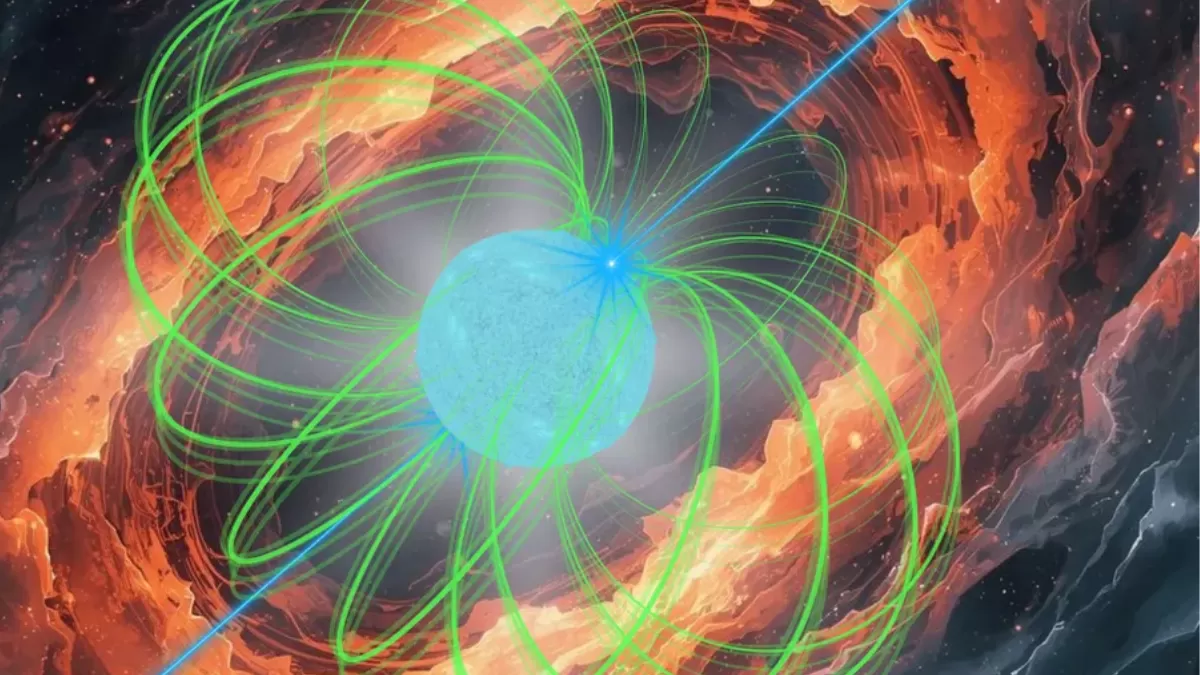
Astronomers have recently made a groundbreaking discovery that has challenged long-held theories about pulsars. These rapidly spinning neutron stars have been found to emit radio waves far beyond their magnetic poles, reaching the edges of their magnetic fields. This unexpected finding has opened up new possibilities for scientists to discover more pulsars and improve their understanding of gravitational waves.
Pulsars are one of the most fascinating objects in our universe. They are incredibly dense and compact neutron stars that emit beams of radiation as they rotate at incredibly high speeds. These beams of radiation can be detected as pulses of radio waves, hence the name “pulsars”. For decades, it was believed that these radio waves were emitted from the magnetic poles of pulsars, similar to how a lighthouse emits light in a specific direction.
However, a team of astronomers from the University of Toronto has discovered that this is not always the case. Using the Canadian Hydrogen Intensity Mapping Experiment (CHIME) telescope, the team observed a pulsar known as PSR J1906+0746. This pulsar is located about 25,000 light-years away from Earth and is known for its incredibly fast rotation, completing one rotation every 144 milliseconds.
To their surprise, the team found that the radio waves emitted by PSR J1906+0746 were not just coming from its magnetic poles. Instead, the radio waves were reaching the edges of its magnetic field, which is about 1,000 times larger than the distance between the pulsar’s poles. This means that the radio waves are being emitted from a much wider area than previously thought.
This finding has challenged the long-held belief that pulsars only emit radio waves from their magnetic poles. It also raises questions about how these radio waves are produced and why they are not confined to the poles. The team believes that this discovery could help scientists better understand the complex magnetic fields of pulsars and how they interact with their surroundings.
But the implications of this discovery go beyond just understanding pulsars. It could also have a significant impact on the detection of gravitational waves. Gravitational waves are ripples in the fabric of space-time that are produced by massive objects, such as black holes or neutron stars, when they collide. These waves are incredibly difficult to detect, but they provide valuable information about the objects that produce them.
Currently, scientists use a technique called pulsar timing to detect gravitational waves. This involves measuring the precise arrival times of radio pulses from pulsars and looking for any slight variations caused by the passing of a gravitational wave. However, this method is limited by the assumption that pulsars only emit radio waves from their magnetic poles. With the new discovery, scientists can now expand their search to include the edges of pulsar’s magnetic fields, increasing their chances of detecting gravitational waves.
Furthermore, this discovery could also lead to the discovery of more pulsars. Pulsars are notoriously difficult to find, and this new understanding of their radio emission could help scientists identify more of these elusive objects. This, in turn, could provide valuable insights into the evolution of stars and the formation of neutron stars.
The team’s findings have been published in the journal Nature and have already sparked excitement among the scientific community. Dr. Cherry Ng, the lead author of the study, said, “This is truly an exciting discovery that challenges our current understanding of pulsars. It opens up a whole new avenue for research and could lead to even more surprising discoveries.”
The discovery of pulsars emitting radio waves beyond their magnetic poles is a testament to the ever-evolving nature of science. It reminds us that there is still so much we have yet to uncover about our vast and mysterious universe. With new technologies and innovative research, we can continue to push the boundaries of our knowledge and unravel the secrets of the cosmos. Who knows what other surprises pulsars and other celestial objects have in store for us? The possibilities are endless, and the future of astronomy looks brighter than ever.

