
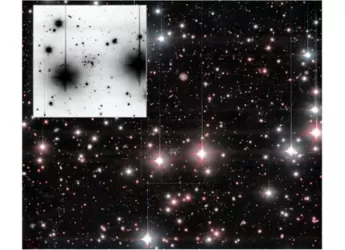
Astronomers have made an exciting discovery that could shed light on the mysteries of the early universe. They have found a new satellite galaxy, named Andromeda XXXVI, orbiting the Andromeda Galaxy. This ultra-faint galaxy is rich in dark matter and is believed to be a fossil from the early universe. This discovery has the potential to greatly advance our understanding of galaxy formation and the elusive dark matter.
The Andromeda Galaxy, also known as Messier 31, is the closest spiral galaxy to our own Milky Way. It is located about 2.5 million light-years away and is visible to the naked eye in the night sky. It is a popular target for astronomers and has been extensively studied over the years. However, the recent discovery of Andromeda XXXVI has opened up a whole new realm of possibilities for research.
Andromeda XXXVI was first spotted by a team of astronomers led by Dr. Nicolas Martin from the University of Strasbourg in France. They used the Canada-France-Hawaii Telescope on Mauna Kea, Hawaii to observe the Andromeda Galaxy and its surroundings. The team noticed a faint glow of stars that did not belong to the Andromeda Galaxy. Further analysis revealed that these stars were part of a separate galaxy, now known as Andromeda XXXVI.
What makes this discovery even more intriguing is the fact that Andromeda XXXVI is an ultra-faint galaxy. This means that it is extremely dim and has a low number of stars. In fact, it is estimated to have only about 1000 stars, compared to the billions of stars in the Andromeda Galaxy. This makes it one of the smallest galaxies ever discovered.
But what makes Andromeda XXXVI truly unique is its high concentration of dark matter. Dark matter is a mysterious substance that makes up about 85% of the total matter in the universe. It does not emit or absorb light, making it invisible to telescopes. Its existence is inferred through its gravitational effects on visible matter. Andromeda XXXVI is believed to have a mass of about 10 million times that of the Sun, with most of it being dark matter.
This makes Andromeda XXXVI a valuable tool for studying dark matter. Dr. Martin and his team believe that this ancient galaxy could be a fossil from the early universe, dating back to the time when the first galaxies were forming. This means that it could provide valuable insights into the role of dark matter in the formation and evolution of galaxies.
The discovery of Andromeda XXXVI also has implications for our understanding of the Andromeda Galaxy itself. It is believed that the Andromeda Galaxy has cannibalized many smaller galaxies over its lifetime, absorbing their stars and dark matter. Andromeda XXXVI could be one of these galaxies, providing clues about the past interactions of the Andromeda Galaxy with its smaller companions.
This discovery has generated a lot of excitement among the scientific community. Dr. Martin describes Andromeda XXXVI as a “Rosetta Stone” for understanding the early universe. He believes that this galaxy could help answer some of the biggest questions in astrophysics, such as the nature of dark matter and the formation of galaxies.
The discovery of Andromeda XXXVI is a testament to the power of modern telescopes and the perseverance of astronomers. It is a reminder that there is still so much to be discovered and understood about our vast and mysterious universe. This finding also highlights the importance of international collaborations in astronomy, as the team behind this discovery consisted of scientists from France, Canada, and the United States.
In conclusion, the discovery of Andromeda XXXVI is a major breakthrough in the field of astronomy. This ultra-faint, dark matter-rich satellite of the Andromeda Galaxy has the potential to unlock many secrets of the early universe. It is a testament to the endless possibilities of exploration and discovery in the vast expanse of space. As we continue to unravel the mysteries of the universe, we can only imagine what other wonders await us.

